
Engine Oil Bottle Family: Designing 1, 2, 4 and 5 Litre Blow-Molded Bottles
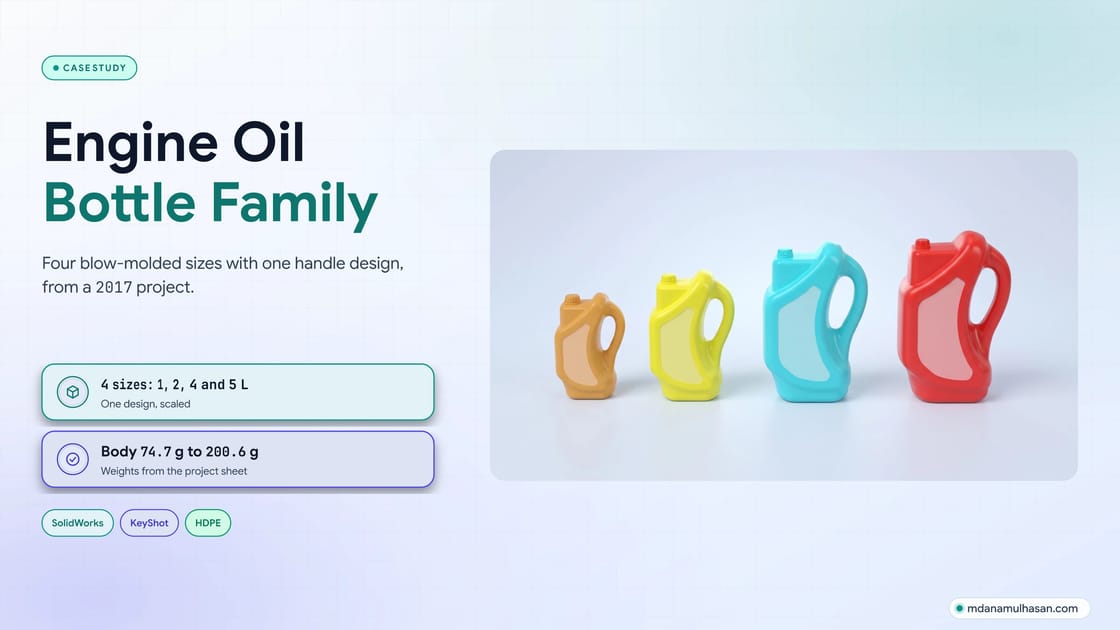
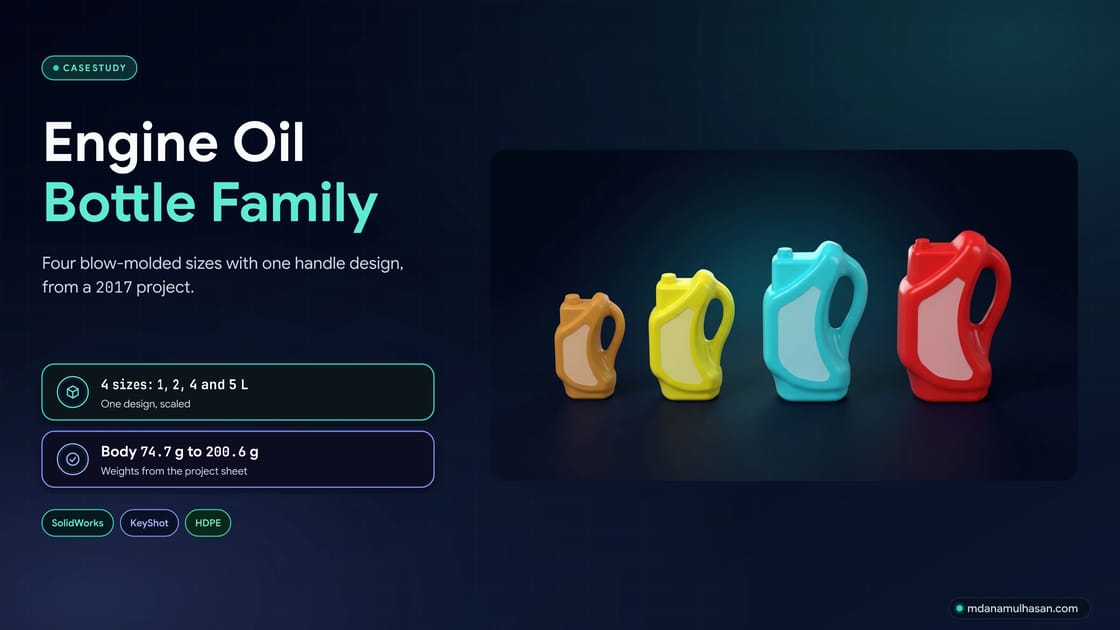
A family of four engine oil bottles, 1, 2, 4 and 5 litres, designed in 2017 as one scaled blow-molded shape with a separate cap, modelled in SolidWorks and rendered in KeyShot.
- Client
- Personal project
- Role
- Designer
- Timeline
- Started Nov 2017
- Stack
- SolidWorks, KeyShot, Blow molding +3
Case study
Challenge & Solution
The project
In November 2017 I designed a family of engine oil bottles as a personal project: four sizes, 1 L, 2 L, 4 L and 5 L, each a blow-molded body with a separate screw cap. I started from the internet and from bottles already on the market, modelled the family in SolidWorks 2017, rendered it in KeyShot and made the labels in Photoshop and Illustrator. The aim stated on my project slide was a design that cuts cost in production by blow molding and still does its job.
What the design shows
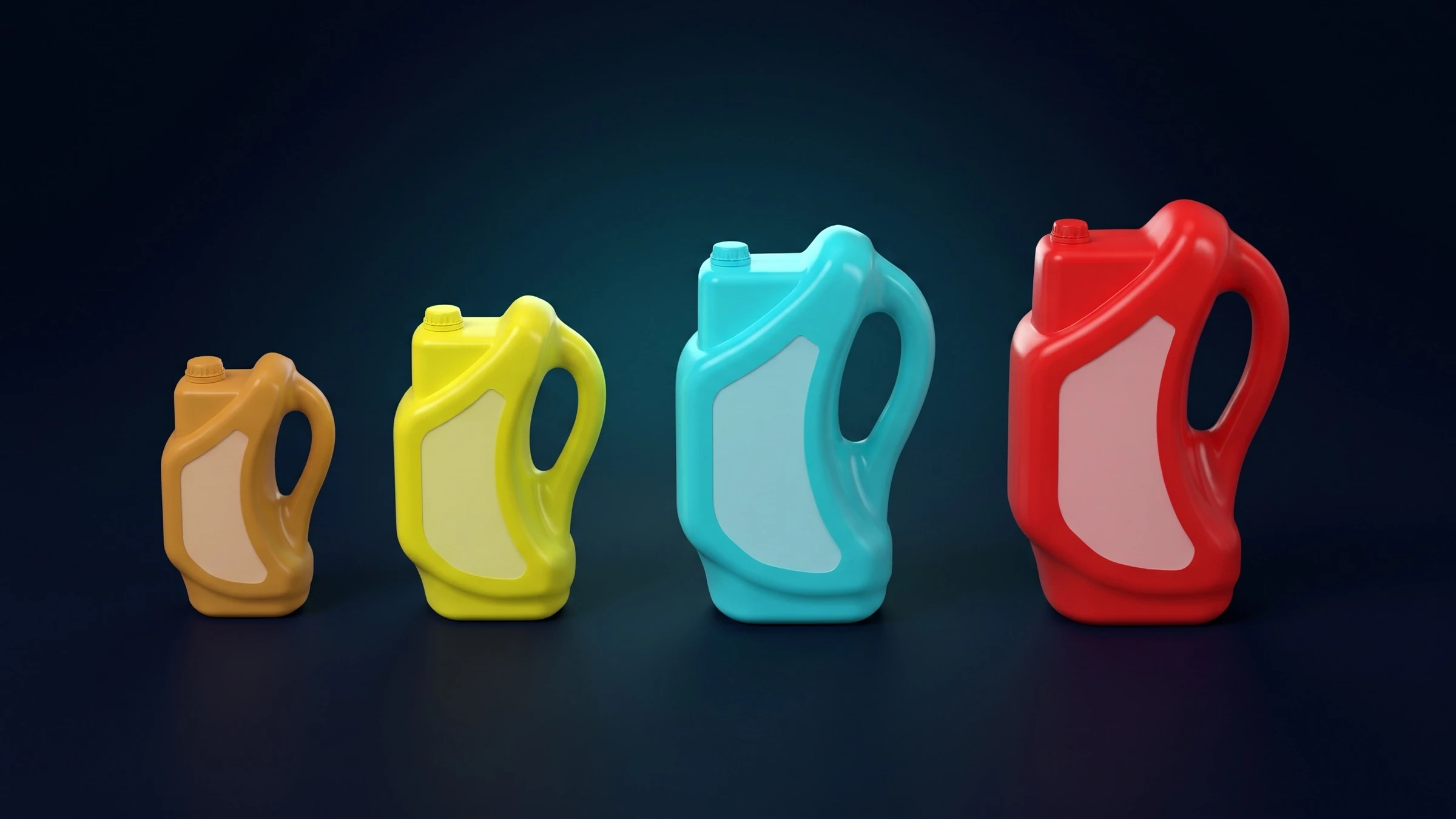
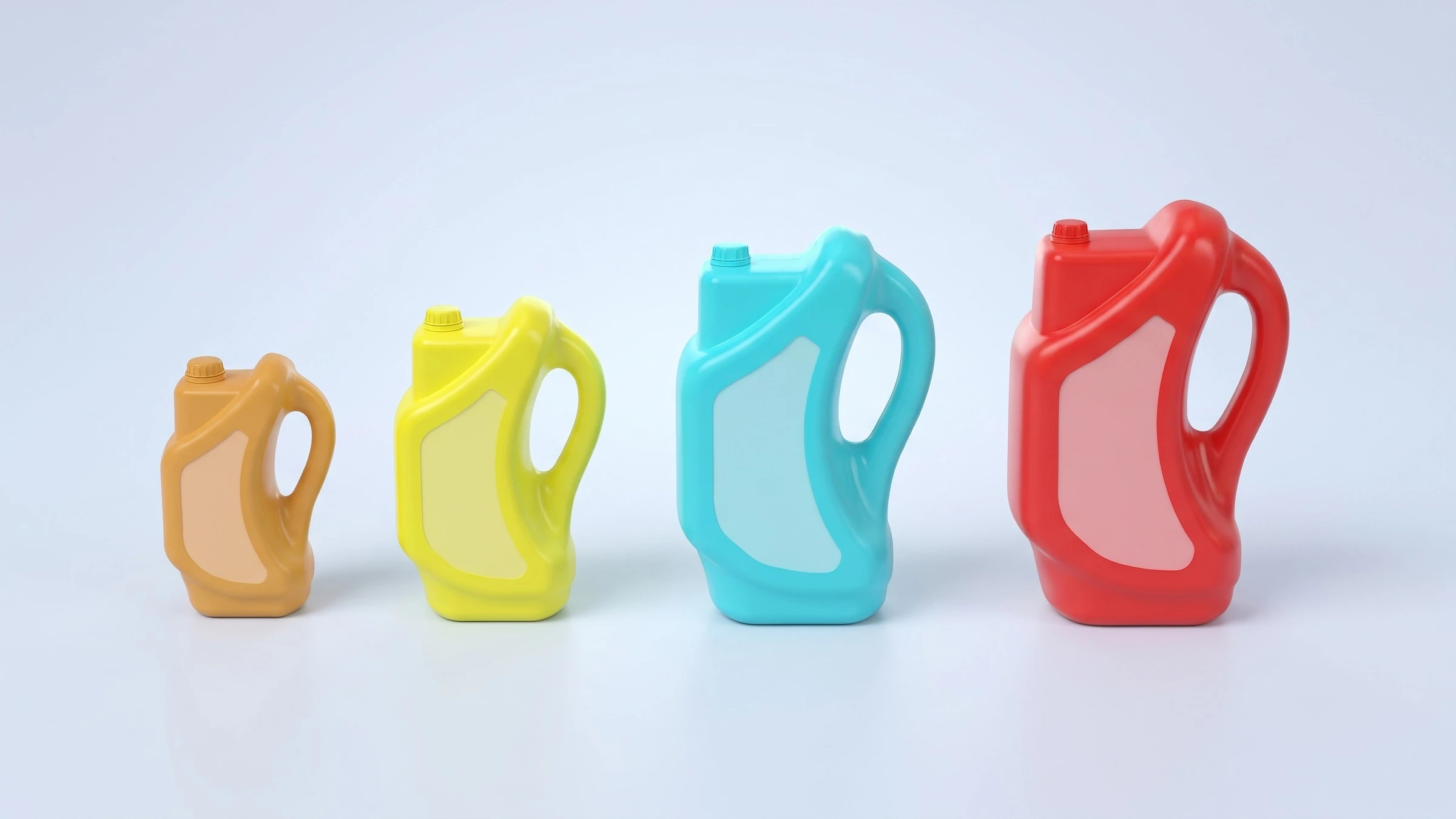
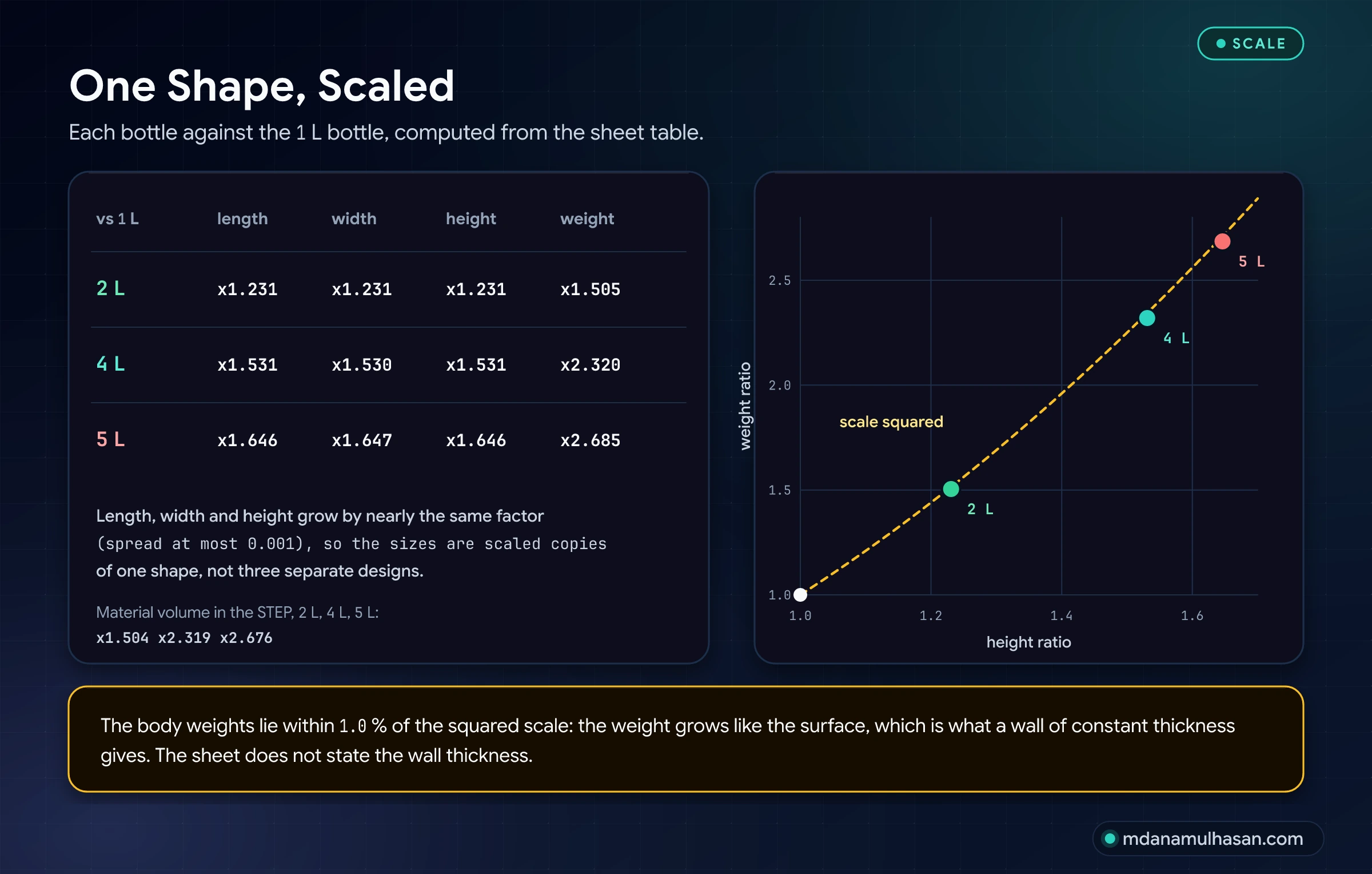
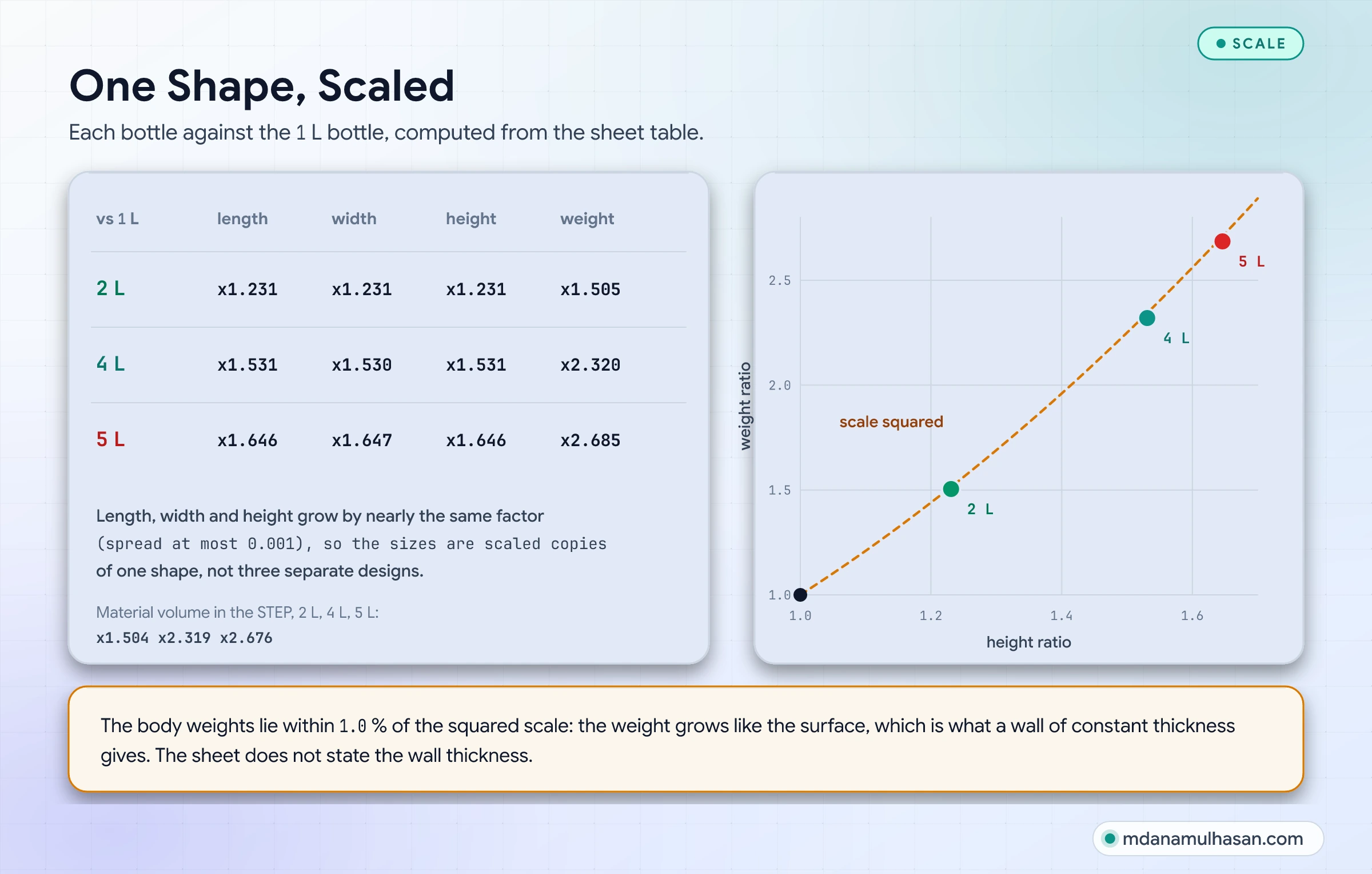
- One shape in four sizes. Length, width and height of the 2 L, 4 L and 5 L bottle are the 1 L bottle times the same factor (1.231, 1.531 and 1.646; the three factors of one bottle differ by at most 0.001).
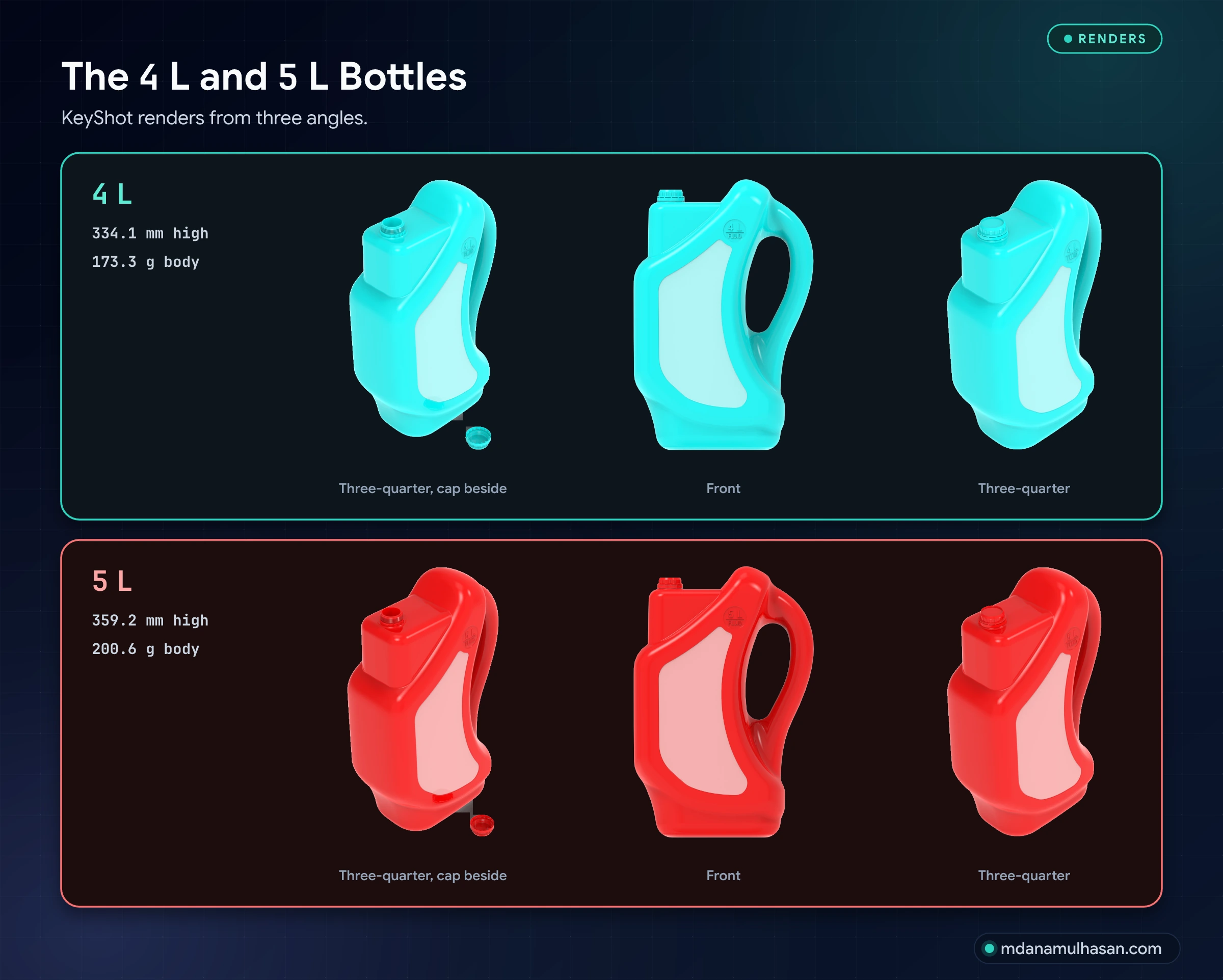
- A carry handle in the body. The handle is an open loop formed in the blow-molded body, on the right of the front view.
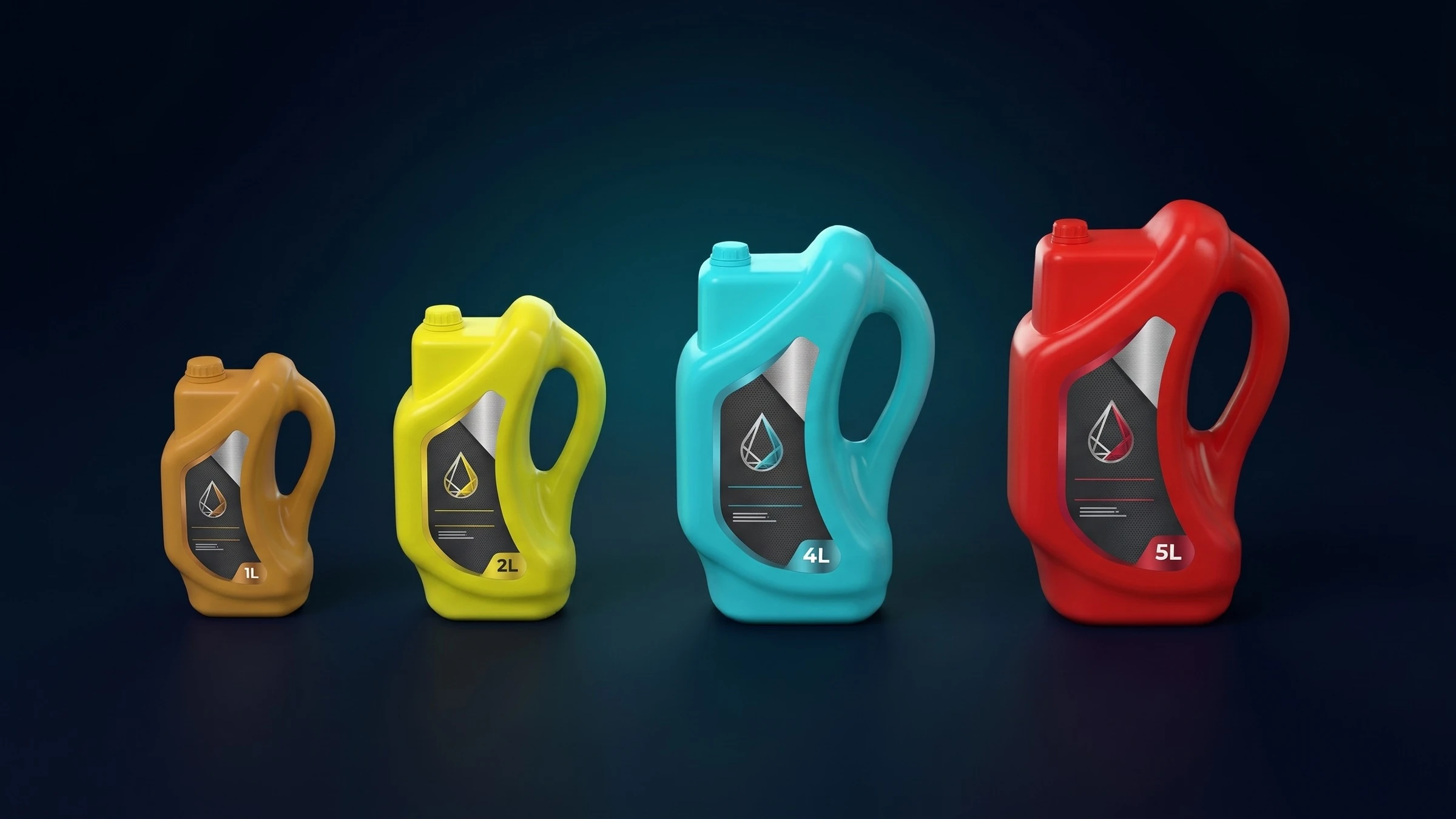
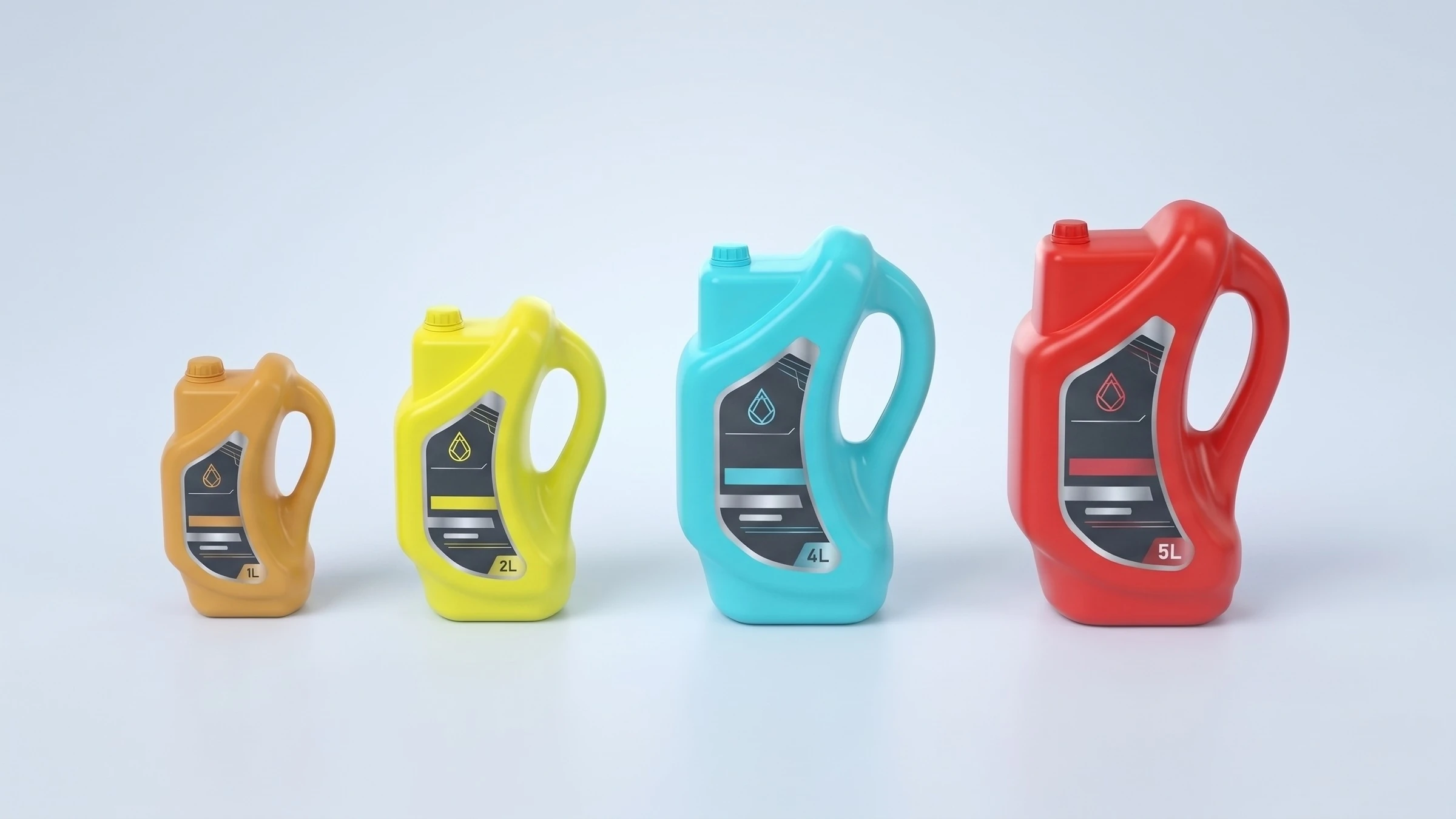
- A pale panel on the front. Every render shows a pale panel on the front face; in the label renders below it carries the label.
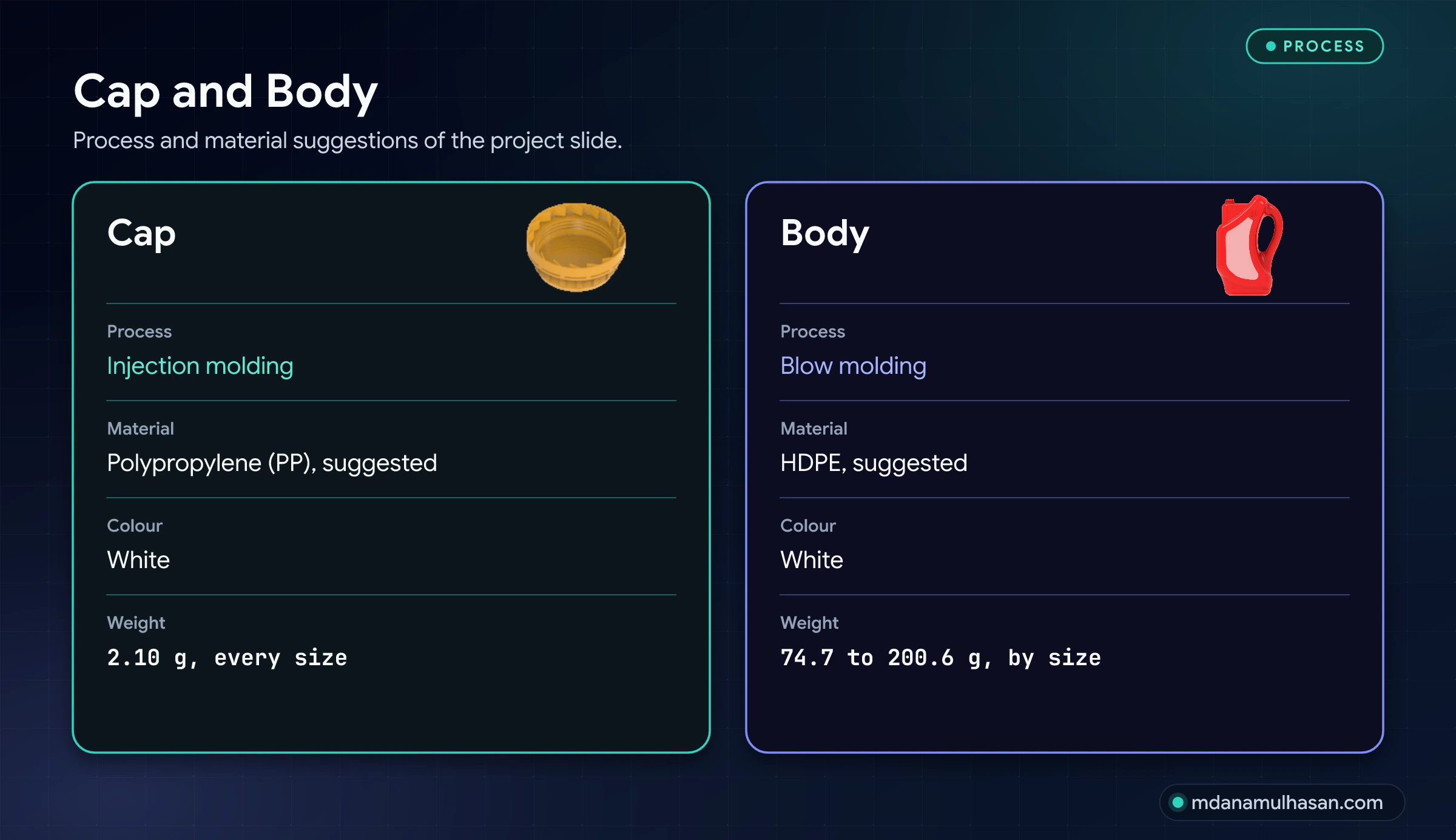
- A separate cap. The cap is its own part and weighs 2.10 g in every size; in the STEP the four caps are identical solids of 33.93 x 13.83 x 33.93 mm.
- A size marking on the 5 L body. The 2021 surface drawing shows a round mark reading “5 L” and “FLUID” on the body.
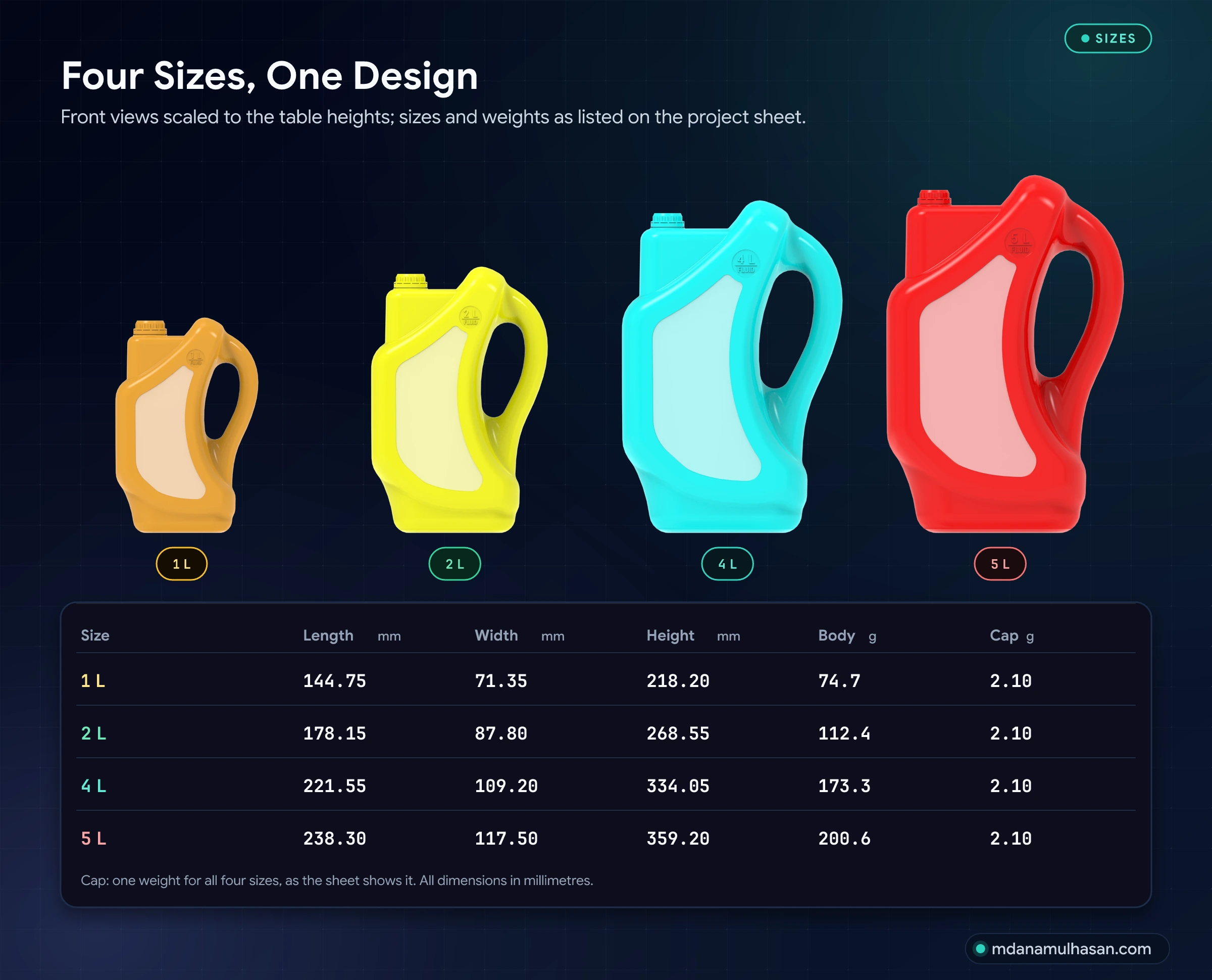
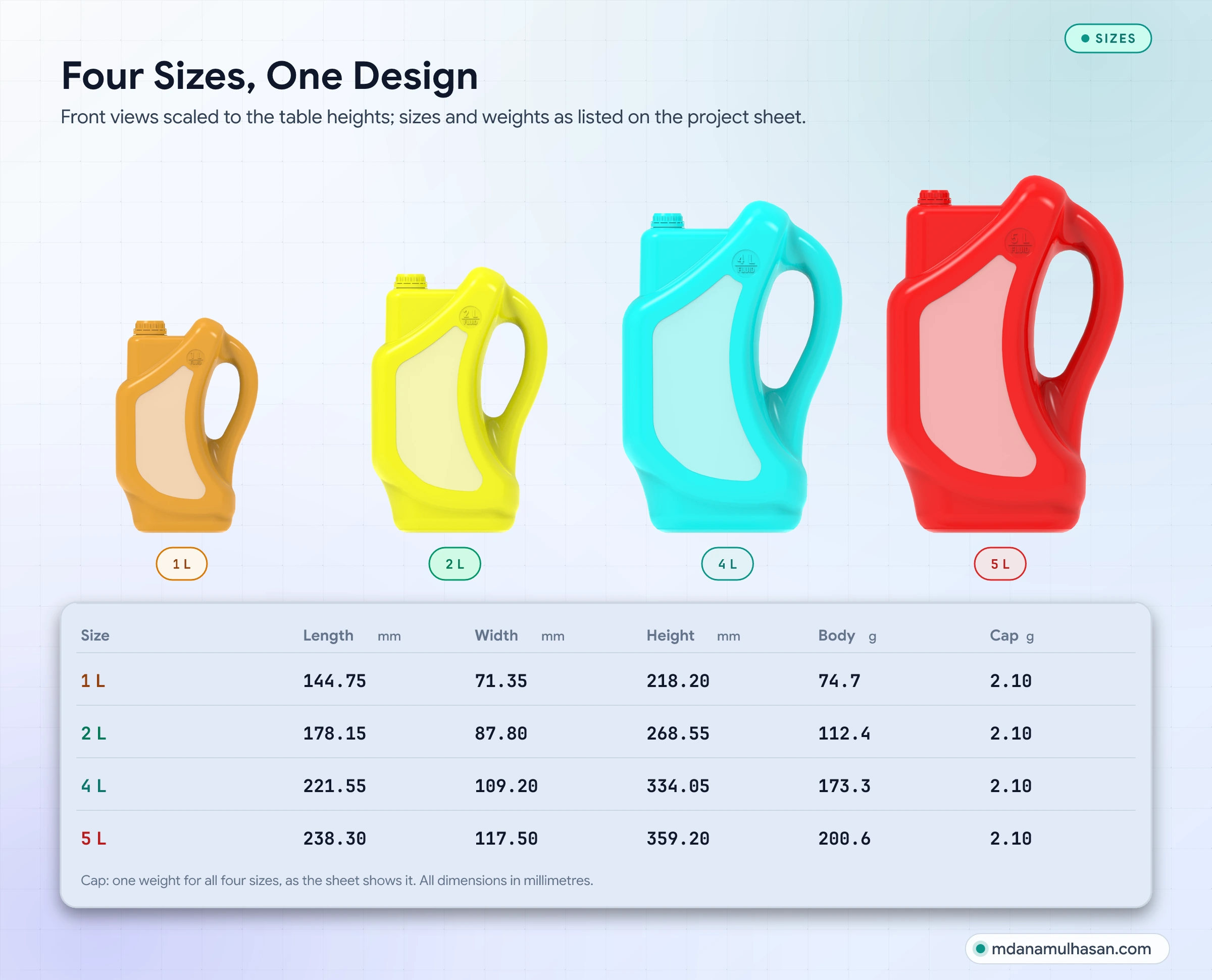
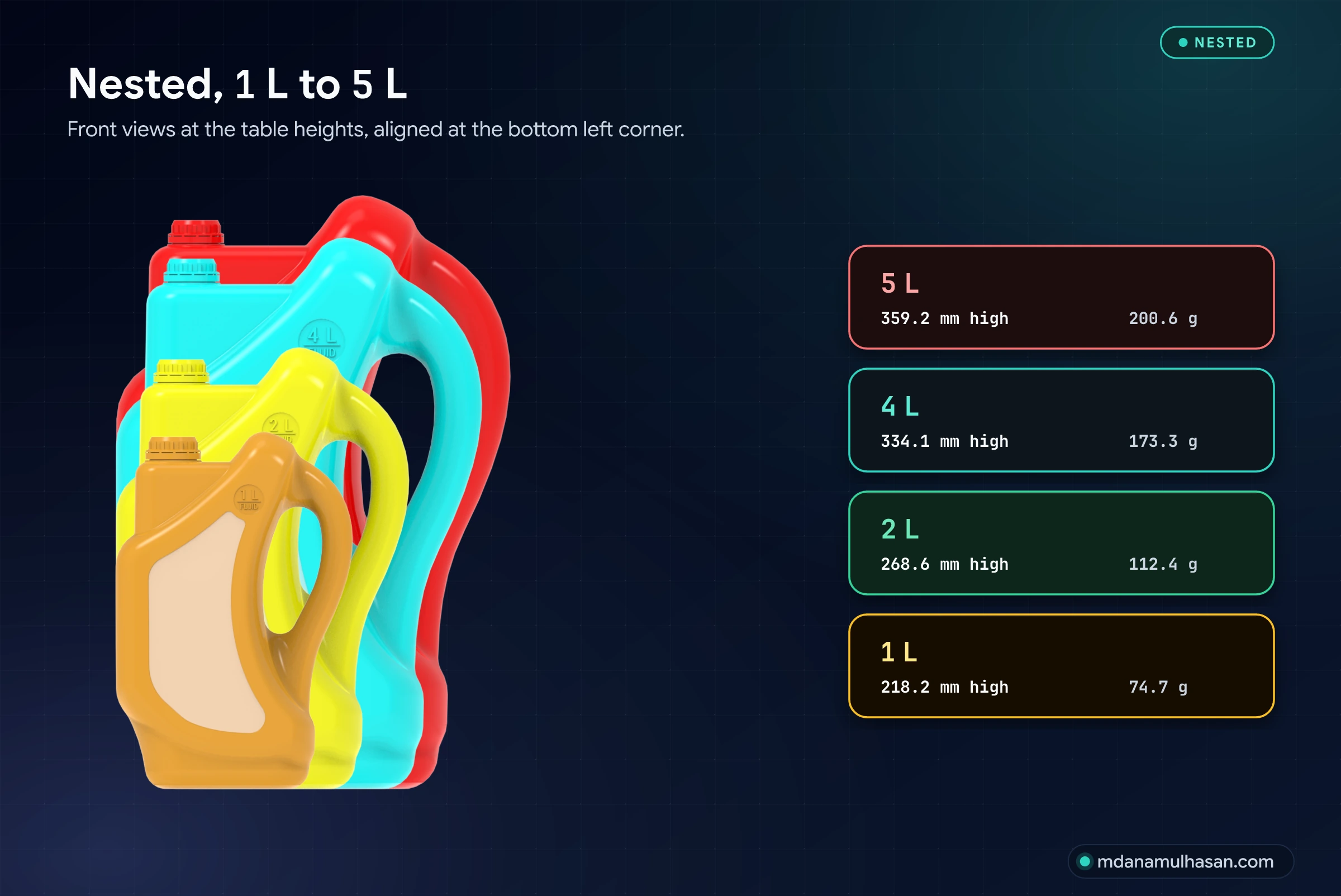
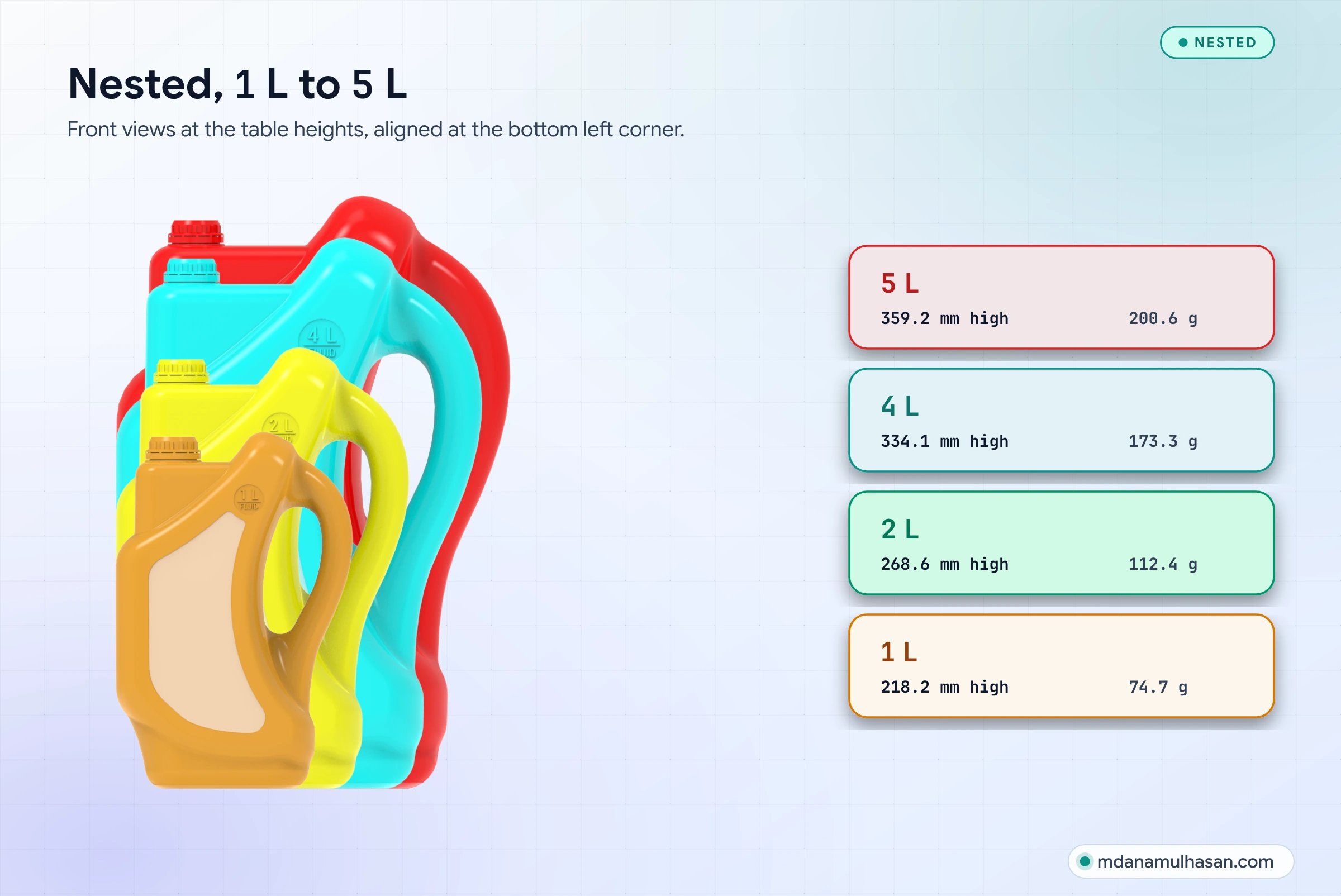
Sizes and weights
The table is from my project slide, in millimetres and grams.
| Size | Length | Width | Height | Body | Cap |
|---|---|---|---|---|---|
| 1 L | 144.75 | 71.35 | 218.20 | 74.7 | 2.10 |
| 2 L | 178.15 | 87.80 | 268.55 | 112.4 | 2.10 |
| 4 L | 221.55 | 109.20 | 334.05 | 173.3 | 2.10 |
| 5 L | 238.30 | 117.50 | 359.20 | 200.6 | 2.10 |
Compared with the 1 L bottle, the body weight of the 2 L, 4 L and 5 L bottle is 1.505, 2.320 and 2.685 times. The square of the height factor gives 1.515, 2.344 and 2.710, so the weights lie within about 1 percent of it: the weight grows like the surface of the bottle, which is what a wall of constant thickness gives. The STEP agrees (see below): the mean wall is about 1.0 mm in all four bodies.
What the STEP says
The assembly file has eight solids: the four bodies and four identical caps. Its numbers agree with the slide table.
| Size | Box in the STEP (length x height x width, mm) | Difference to the slide | Material volume | Mean wall |
|---|---|---|---|---|
| 1 L | 144.81 x 218.21 x 71.38 | 0.06 mm at most | 78.3 cm³ | 1.02 mm |
| 2 L | 178.23 x 268.57 x 87.85 | 0.08 mm at most | 117.7 cm³ | 1.01 mm |
| 4 L | 221.67 x 334.03 x 109.27 | 0.12 mm at most | 181.5 cm³ | 1.01 mm |
| 5 L | 238.38 x 359.21 x 117.50 | 0.08 mm at most | 209.4 cm³ | 1.01 mm |
The slide weights divided by the STEP volumes give 0.954, 0.955, 0.955 and 0.958 g/cm³ for the bodies and 0.954 g/cm³ for the cap, so the weights on the slide are the STEP volumes times a density of about 0.955 g/cm³; the density itself is not on the slide. The mean wall is the volume divided by half the surface area of the thin-walled solid, an estimate and not a measured thickness. The material volumes of the 2 L, 4 L and 5 L body are 1.504, 2.319 and 2.676 times that of the 1 L body, close to the squared scale above.
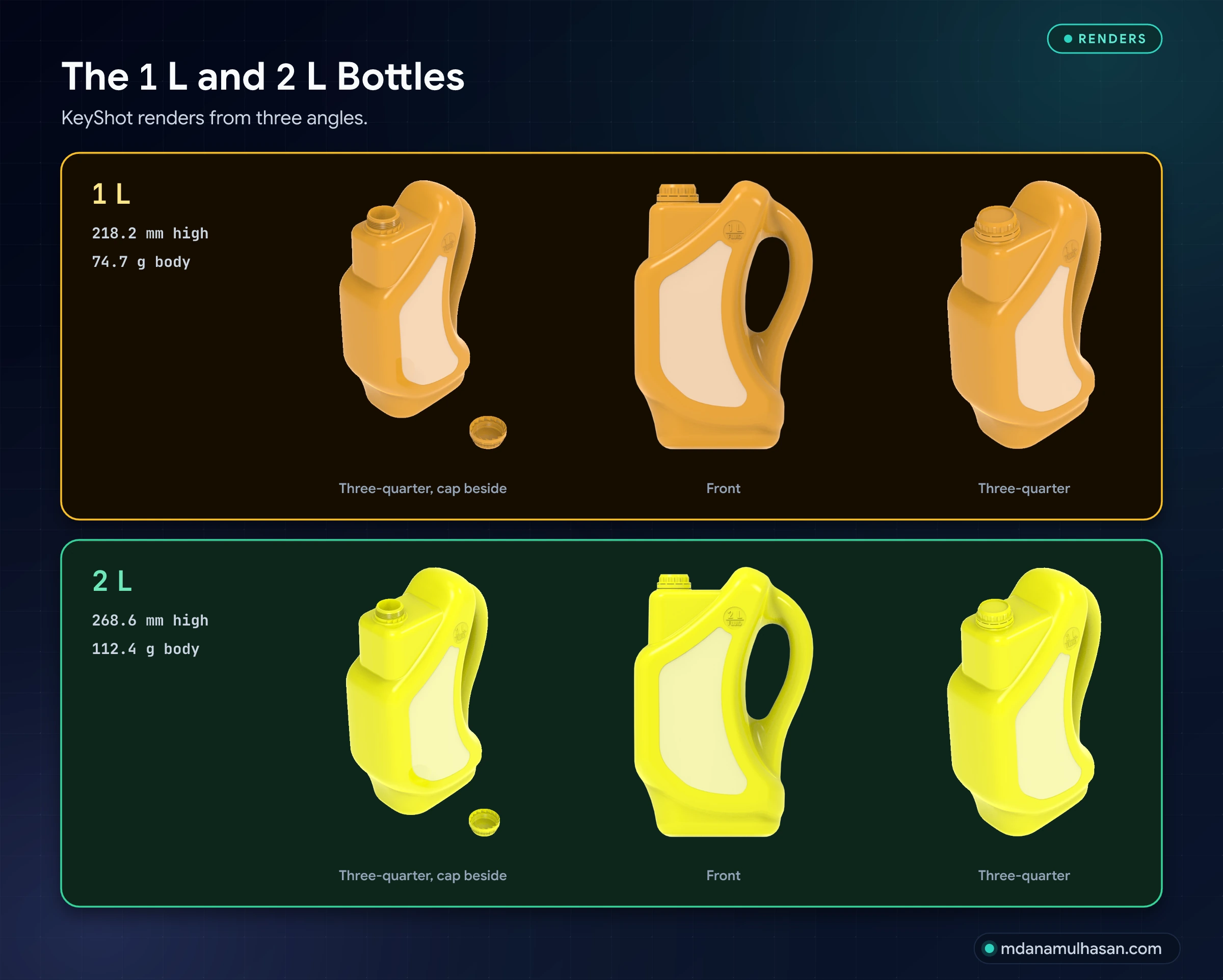
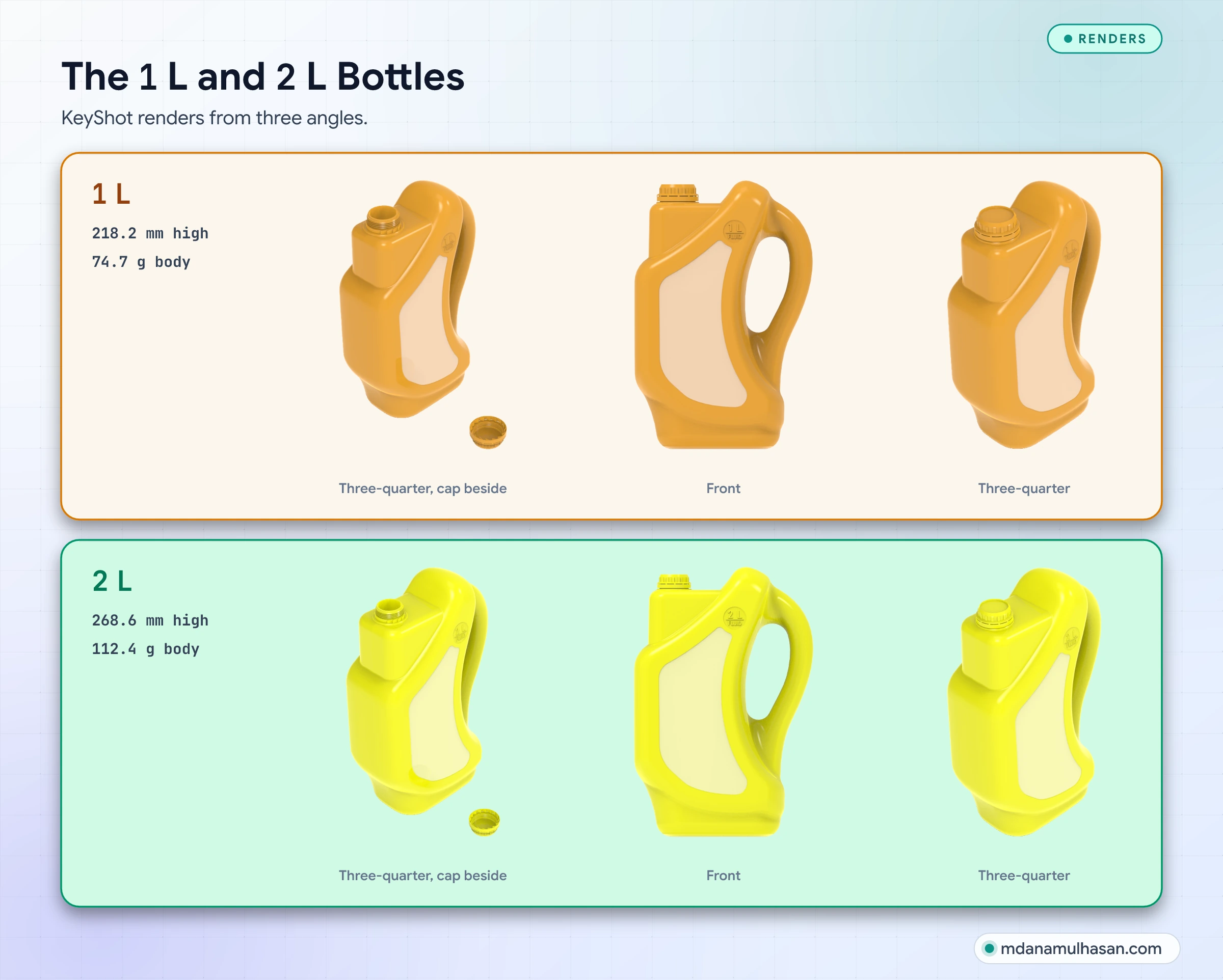
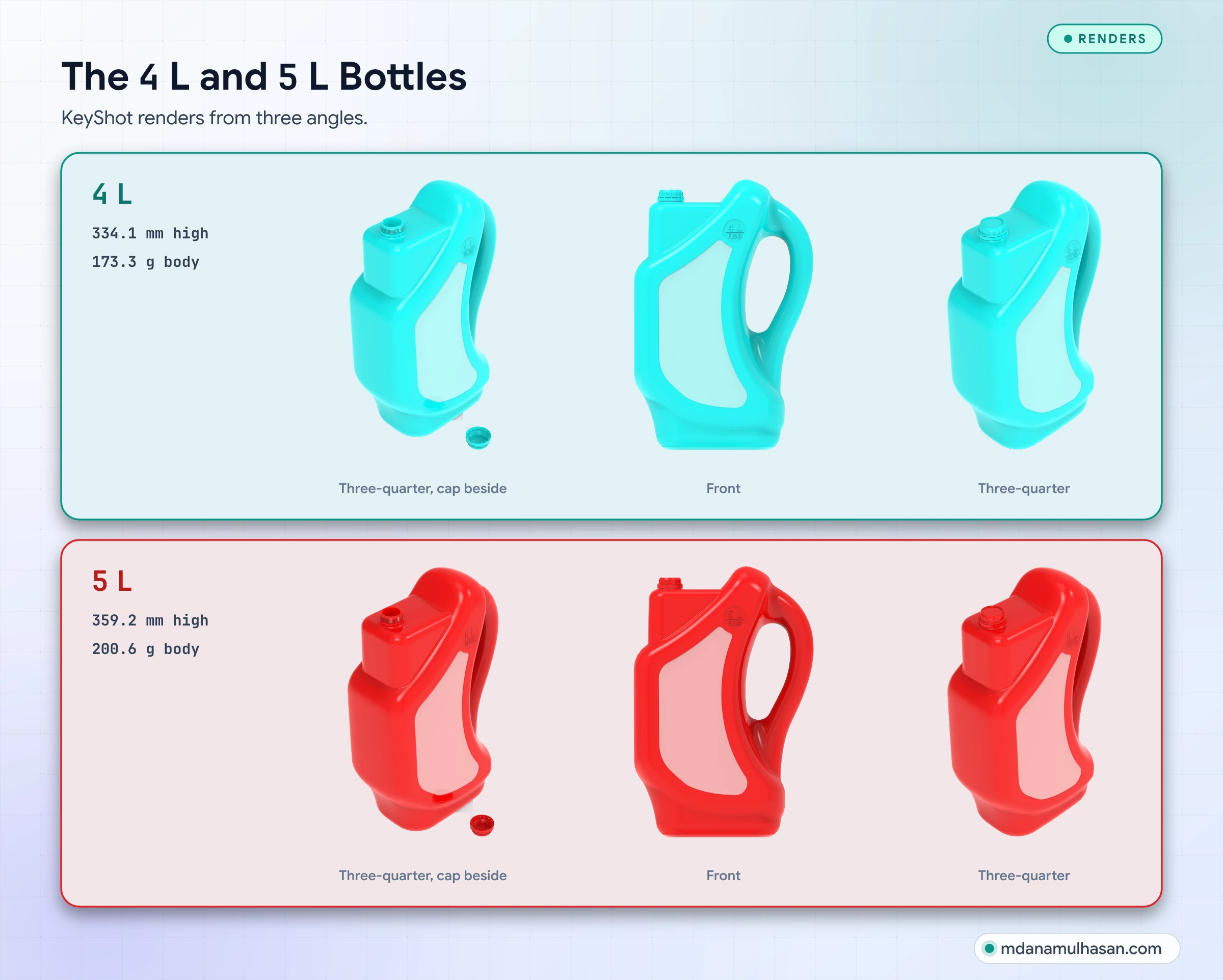
The four bottles in KeyShot
Cap and body
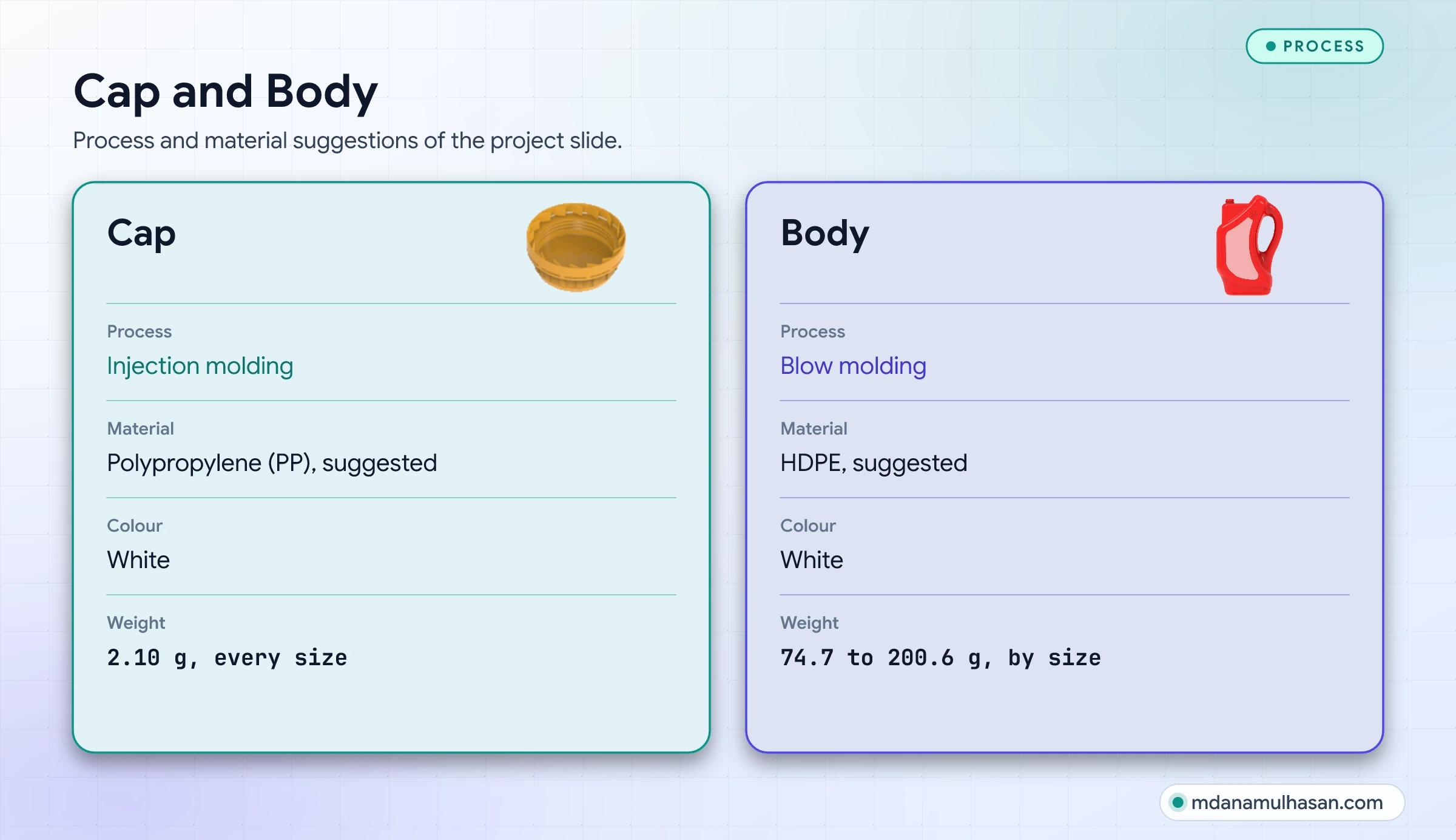
My slide gives a process and a material suggestion for each part: the cap is injection molded in polypropylene (PP), the body is blow molded in HDPE, and both are white. These are suggestions on a slide, not a material or process validation.
The surfaces of the 5 L body
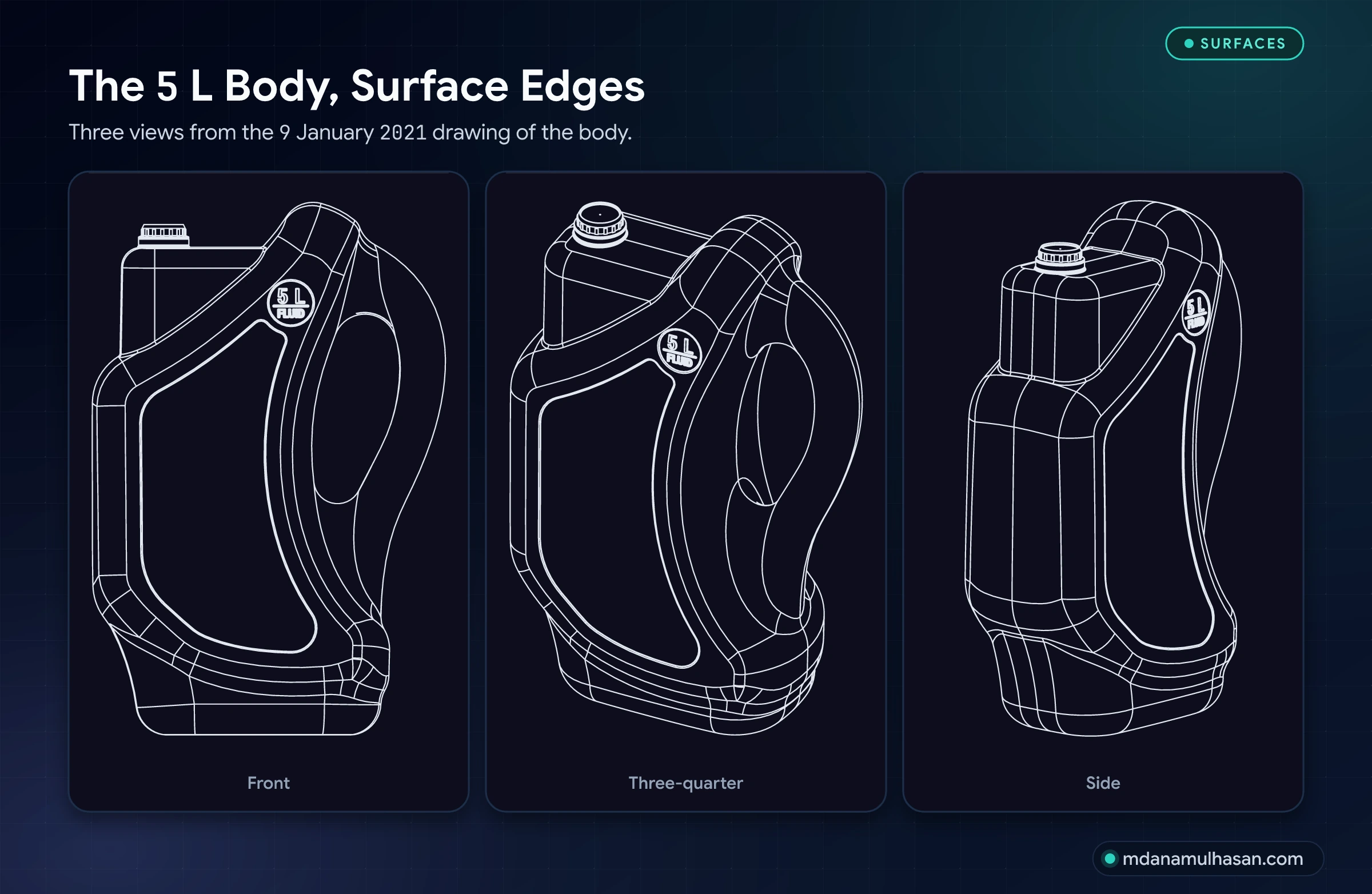
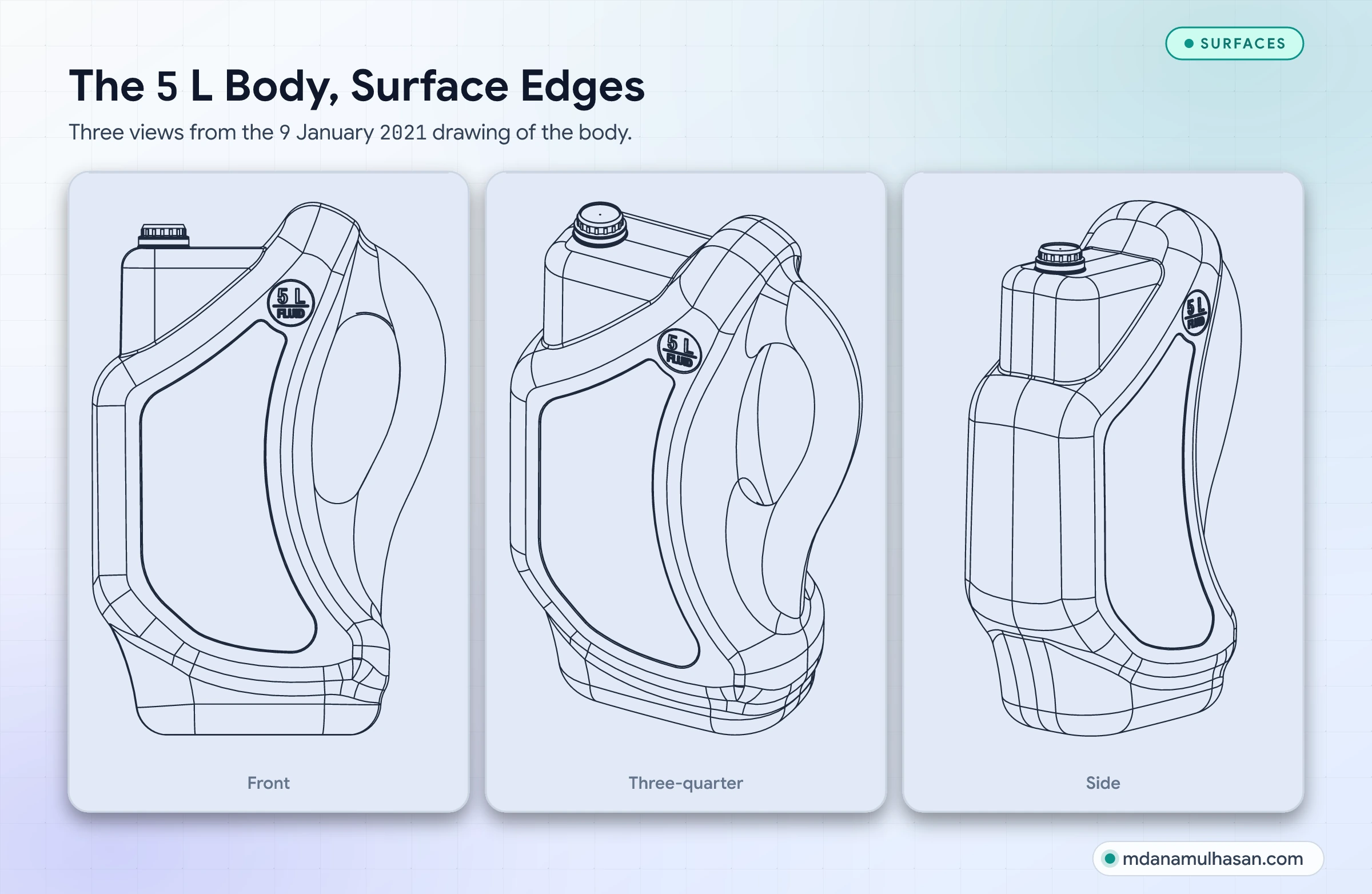
Two sets of heights
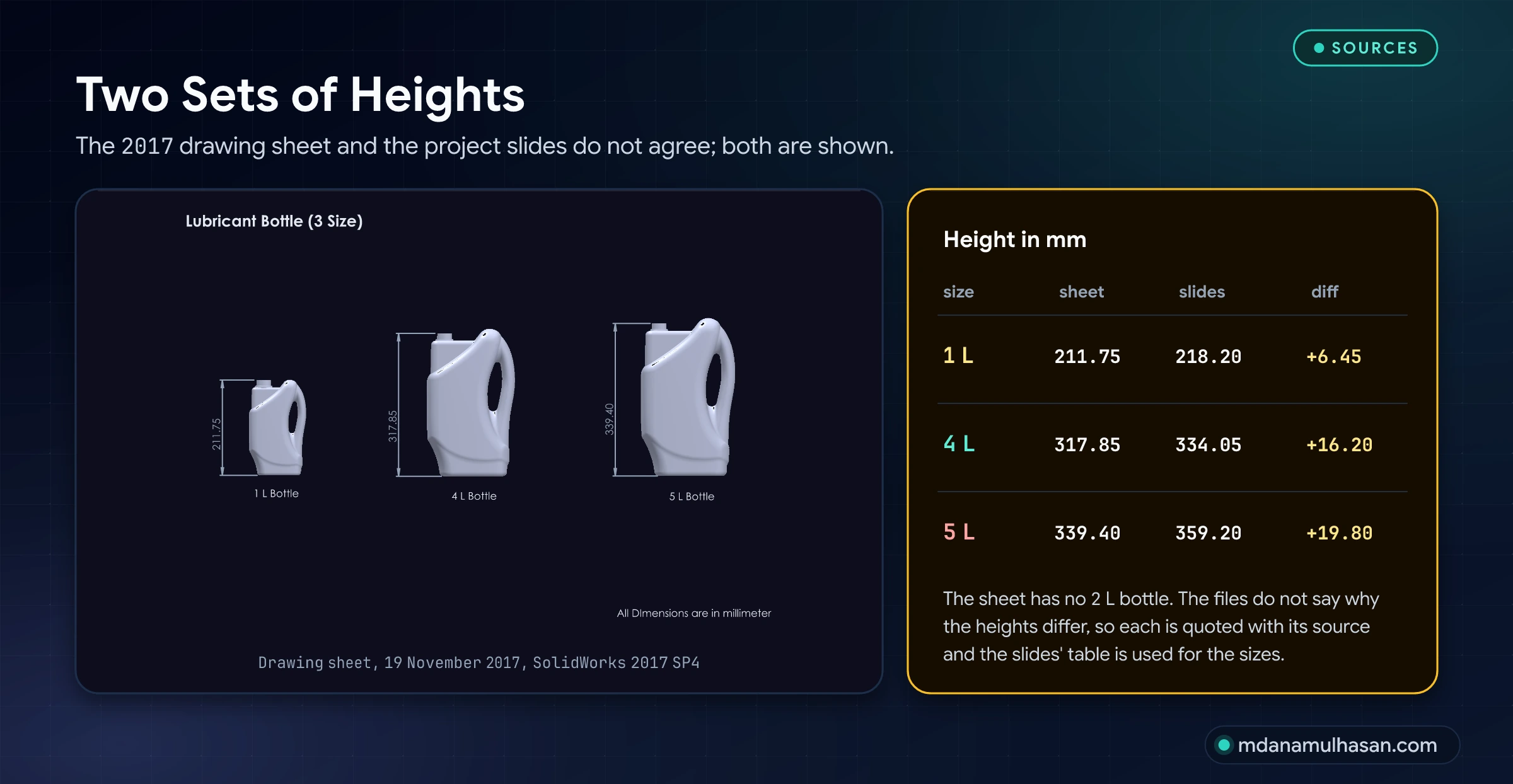
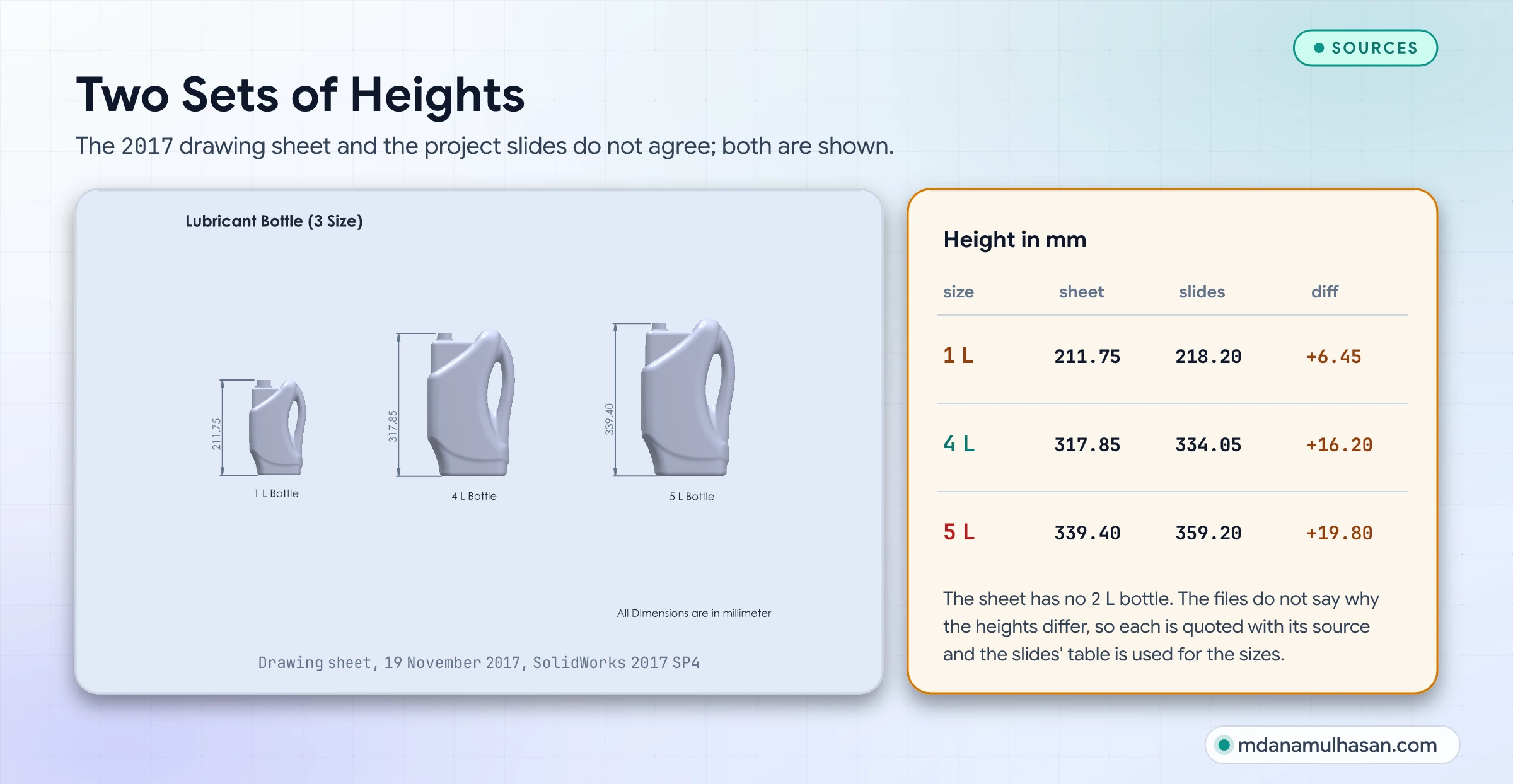
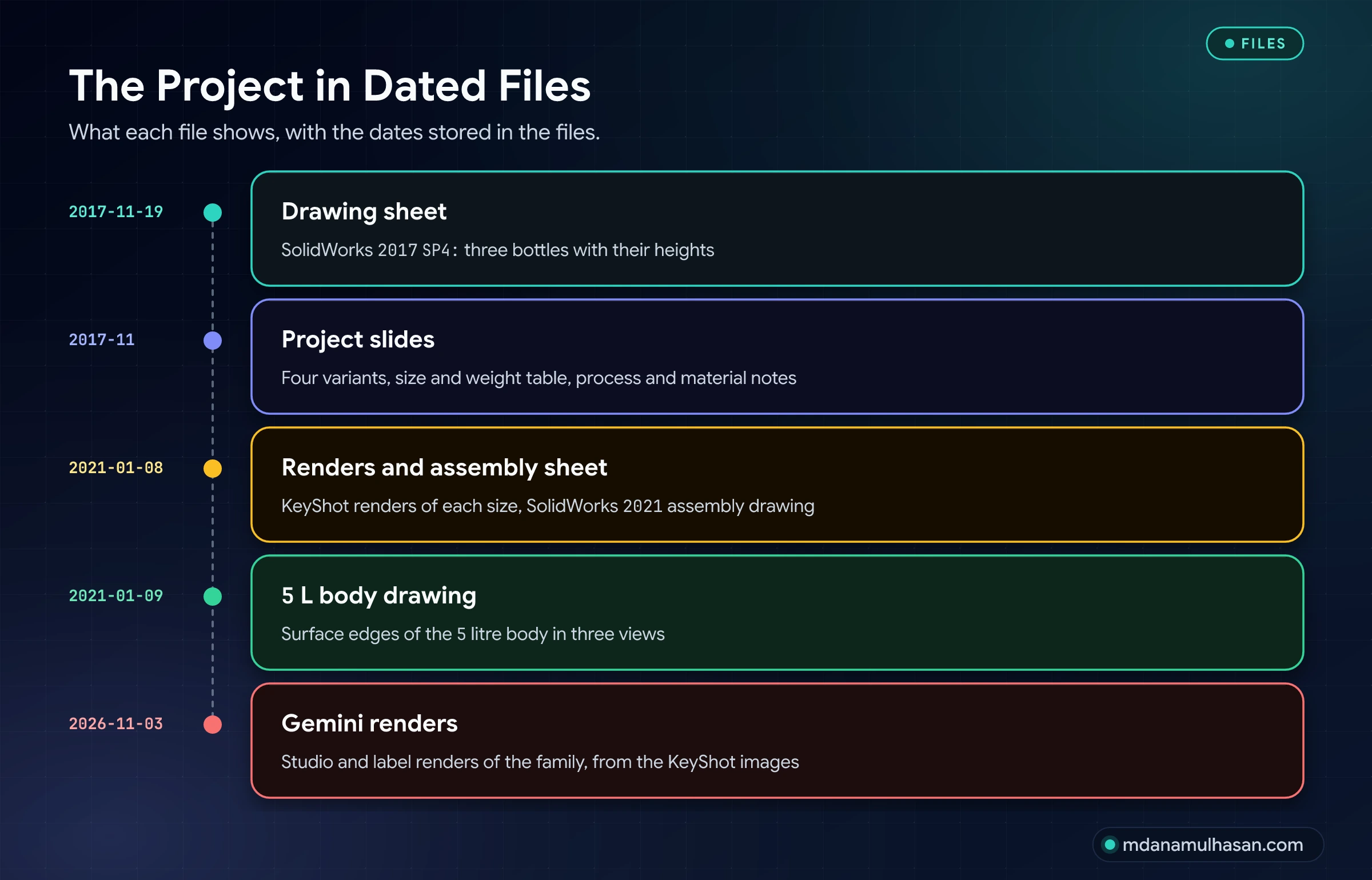
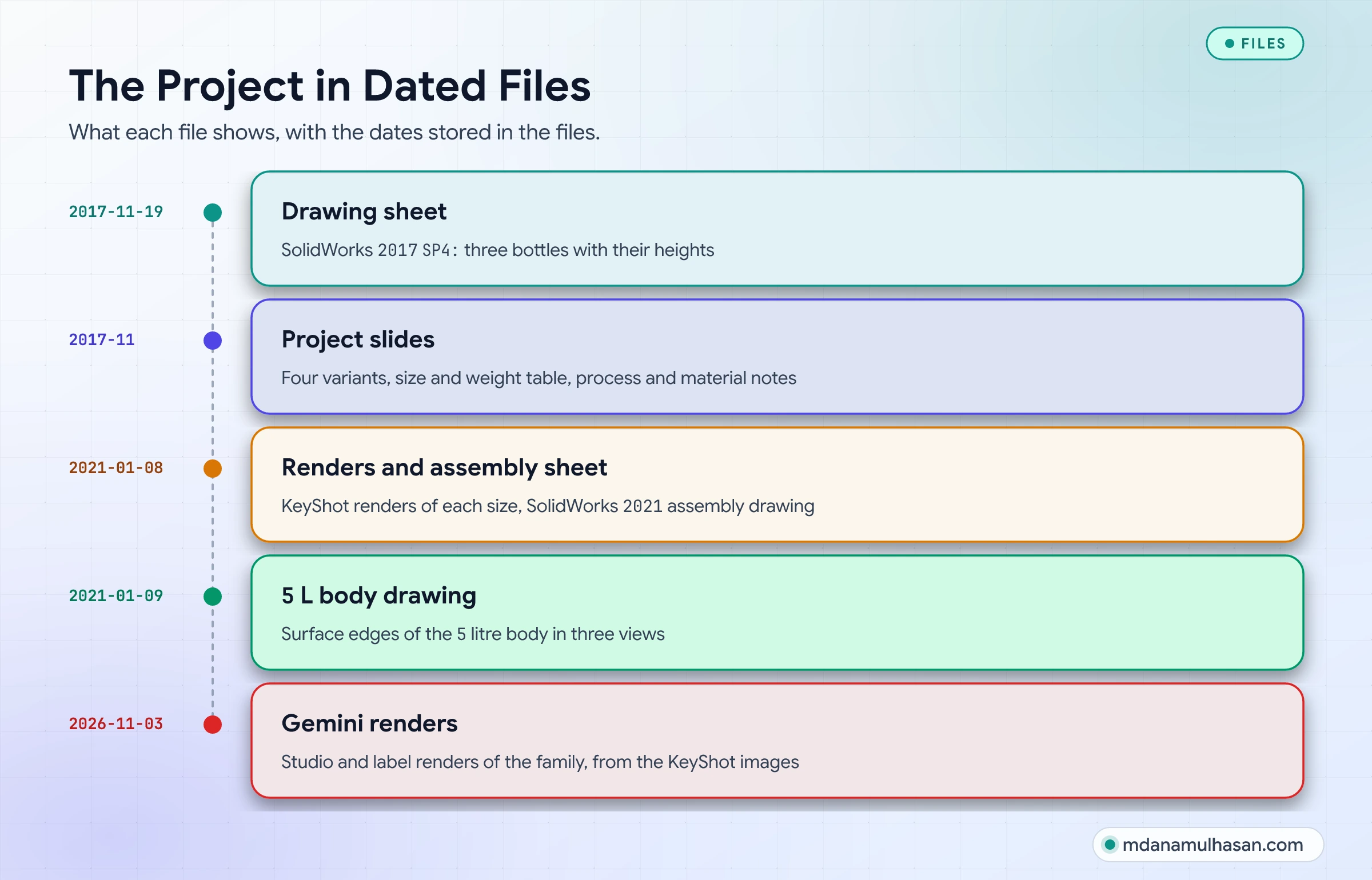
My 2017 drawing sheet gives the height of the 1 L, 4 L and 5 L bottle as 211.75, 317.85 and 339.40 mm. The slide table lists 218.20, 334.05 and 359.20 mm: 6.45, 16.20 and 19.80 mm more. The STEP agrees with the slide table (218.21, 334.03 and 359.21 mm), so the 2017 sheet is the odd one out. The files do not say why it differs, so I quote each with its source and use the slide table, which the STEP confirms, for the sizes in this study.
Label renders
The files behind it
How the numbers were checked
The STEP assembly was opened with a CAD kernel to read the bounding box, volume, face count and surface area of every solid. The sizes, weights and 2017 heights are parsed from the PDFs by script; the factors, the density and the mean wall are computed from those and from the STEP. The silhouettes are my KeyShot renders scaled to the table heights, and the surface views are vector exports from my SolidWorks drawing.
What this study does not claim
The capacity of each bottle is not checked. The four STEP bodies fail the kernel’s validity check (110 to 116 free edges each; the caps pass), so their volumes and the wall estimate carry that caveat, although the volumes agree with the slide weights at one common density, which supports them. My attempt to separate the inner from the outer surface to measure the cavity did not pass its own check, so I do not quote a capacity: the nominal 1, 2, 4 and 5 L are not confirmed. If the bottles were exact scale copies their capacity would grow with the cube of the scale, 1.86, 3.59 and 4.46 times for the 2 L, 4 L and 5 L bottle against nominal 2, 4 and 5 times. The wall thickness is a mean, not a minimum, and the centre of gravity is not computed. Material and process are suggestions on a slide. There is no tooling layout, blow ratio, cycle time, drop test, handle load test or pour test. The 2017 sheet and the slides disagree on heights. The studio and label images were generated from my renders with an image generator; their panels, labels and shading are the generator’s.
Links
Packaging or a plastic part to design for blow molding? Get in touch.
Another product design study with its numbers read from the model: Stackable Drying Drawer. Making parts easy to produce and assemble: the DFMA Design Handbook.
Measurable Impact
Key Outcomes & Performance
Quantified business outcomes and engineering improvements delivered.
Sizes
1, 2, 4 and 5 litre bottles scaled from one shape
Body weight
From the 1 L to the 5 L body, from the project slide
Cap weight
The same injection-molded cap on every size
Visual Documentation
Project Gallery & Technical Visuals
High-precision 3D CAD renders, exploded assemblies, and fabrication documentation.
Process & Milestones
Engineering & Development Journey
From initial requirements gathering to precision modeling and manufacturing validation.
Collect ideas
Nov 2017Bottles on the internet and on the market as the starting point.
Model the family
CADFour bottle bodies and a cap in SolidWorks 2017, with sizes and weights in a table.
Render and label
RenderKeyShot renders of each size; labels made in Photoshop and Illustrator.
Revisit the files
2021A surface drawing of the 5 L body and renders from three angles in 2021.
Technical Stack
Technologies, Tools & Frameworks
Explore Further
More Engineering Case Studies


Coffee Beater Enclosure: Designing a Hand-Held Beater from CAD to Prototype
The housing of a hand-held coffee beater: a two-section faceted enclosure, a nose-cone coupler and an internal spacer, modelled in SolidWorks, rendered, and built as a prototype.
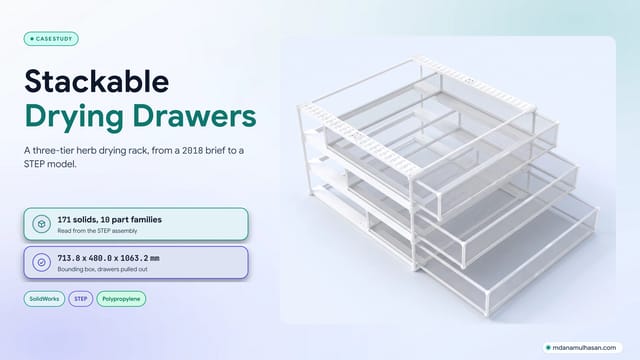
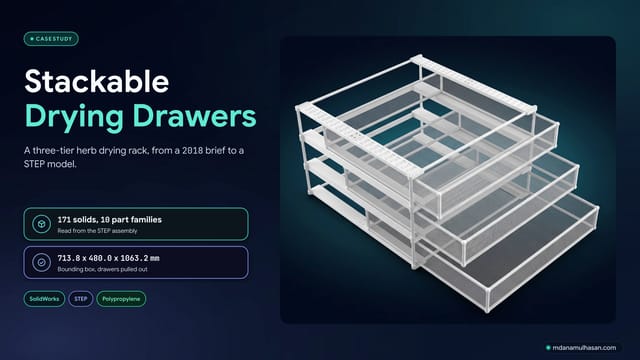
Stackable Drying Drawer for Herbs: Designing a Three-Tier Rack from Brief to CAD
A three-tier herb drying rack: white frames with mesh drawers that slide out in steps, designed from a 2018 brief and modelled as a 171-solid STEP assembly in SolidWorks.