Size the weld, price the seam
Free interactive calculators for fillet weld throat, volume and filler, required leg from load, and stitch versus continuous seam cost, plus a tested zero-dependency Python module and a printable DFM sign-off checklist.
A free toolkit for the weld decisions that are made in CAD: three interactive calculators in the browser, a tested zero-dependency Python module, and a printable sign-off checklist. It accompanies the article Designing Heavy Welded Structures for Manufacturability (DFM), and every number matches that article’s worked examples.
This is a comparison and estimating tool, not a design-code check. The nominal fillet area ignores reinforcement and root penetration. Use the numbers to rank options (6 mm against 12 mm, continuous against stitch), and replace the allowable stress, deposition rate, operator factor and prices with your own code, process and shop data.
Fillet size: throat, volume and filler
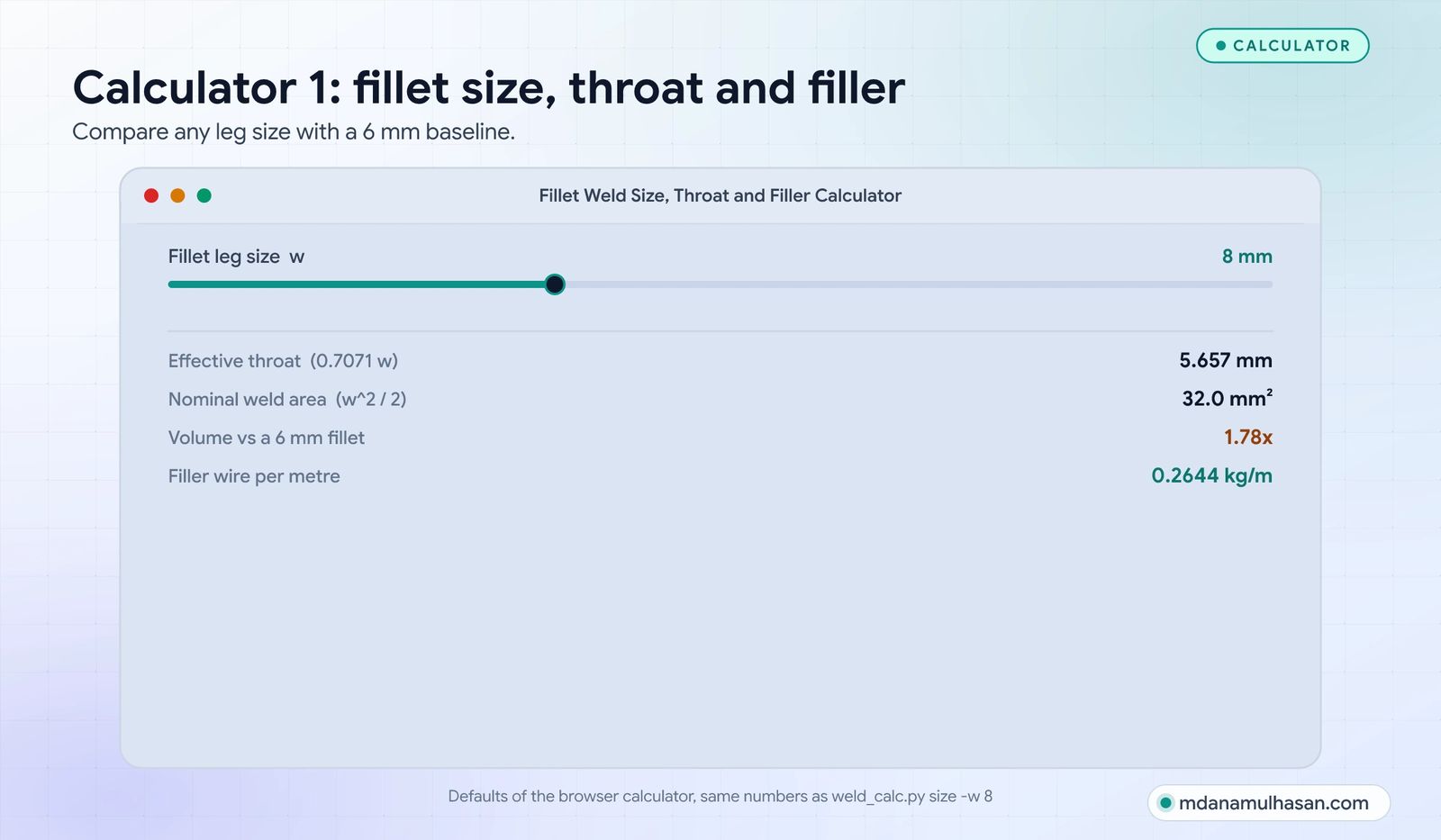
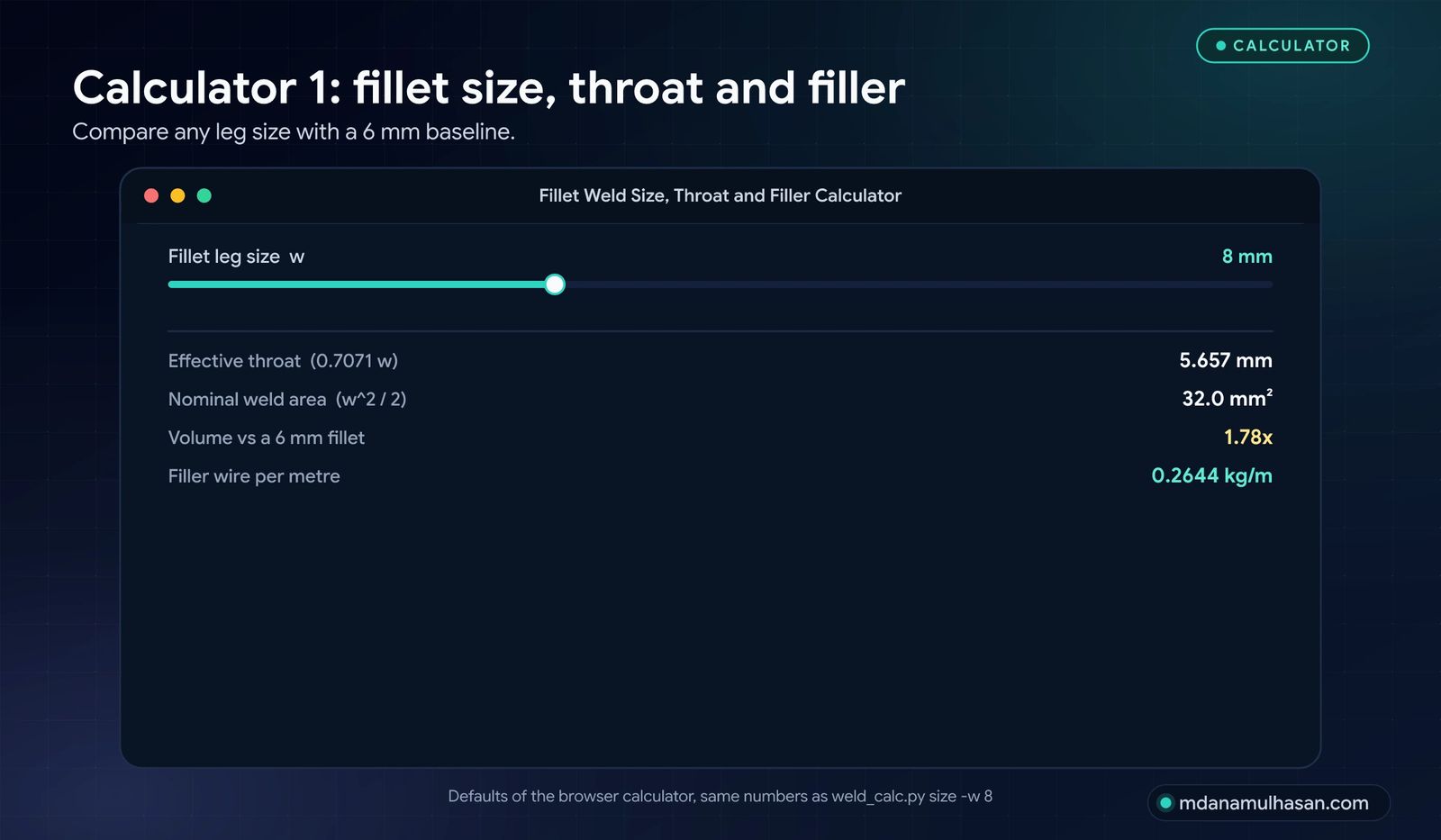
The default is an 8 mm fillet. Compare any leg size with a 6 mm baseline: the weld metal grows with the square of the leg.
Interactive calculator — enable JavaScript to use.
- Fillet Leg Size (w)
| Leg | Throat | Volume vs 6 mm | Typical passes (semi-automatic GMAW) |
|---|---|---|---|
| 6 mm | 4.24 mm | 1.00x | 1 |
| 8 mm | 5.66 mm | 1.78x | 1 |
| 10 mm | 7.07 mm | 2.78x | 2 |
| 12 mm | 8.49 mm | 4.00x | 2 or more |
Required leg from load
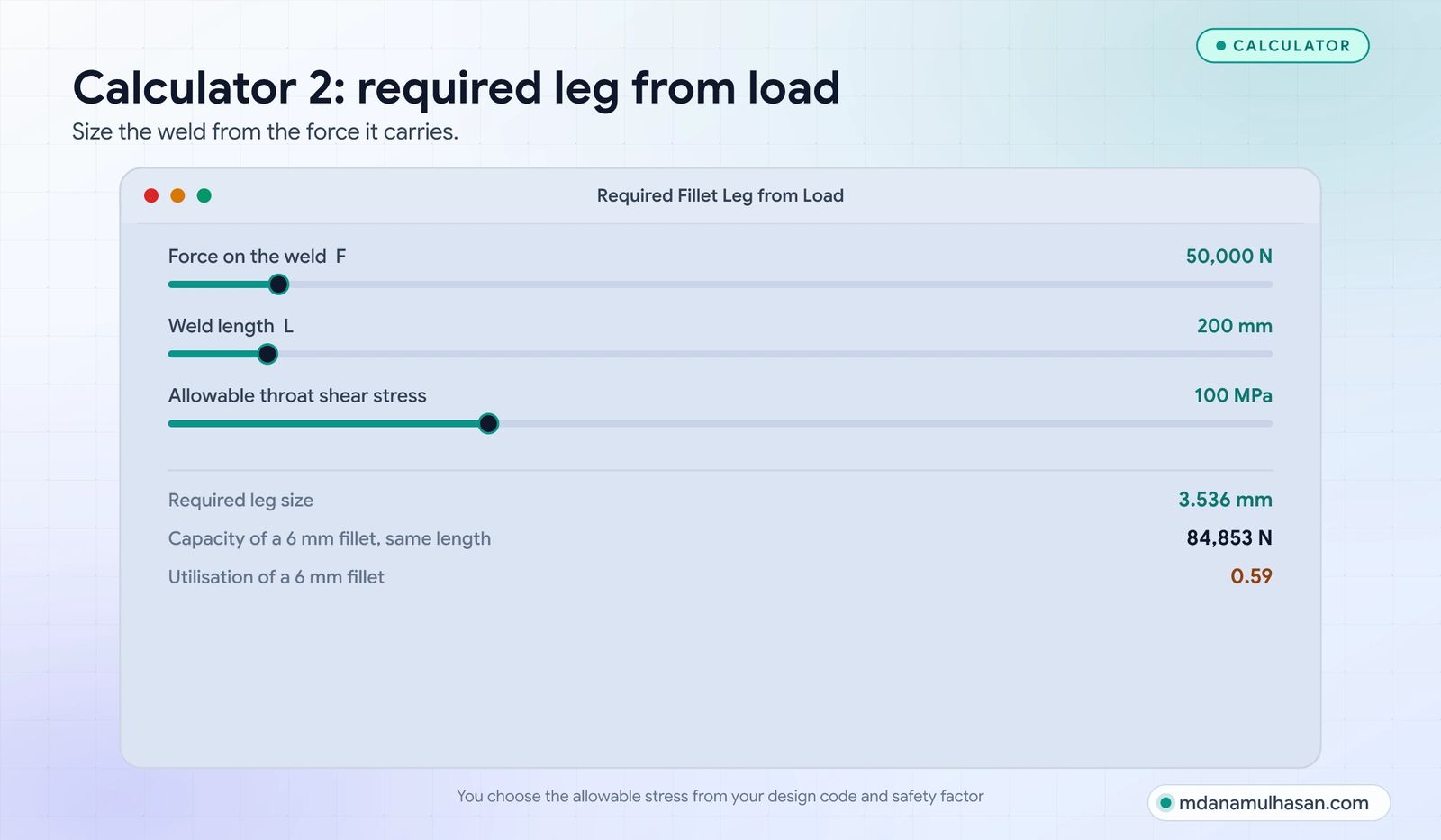
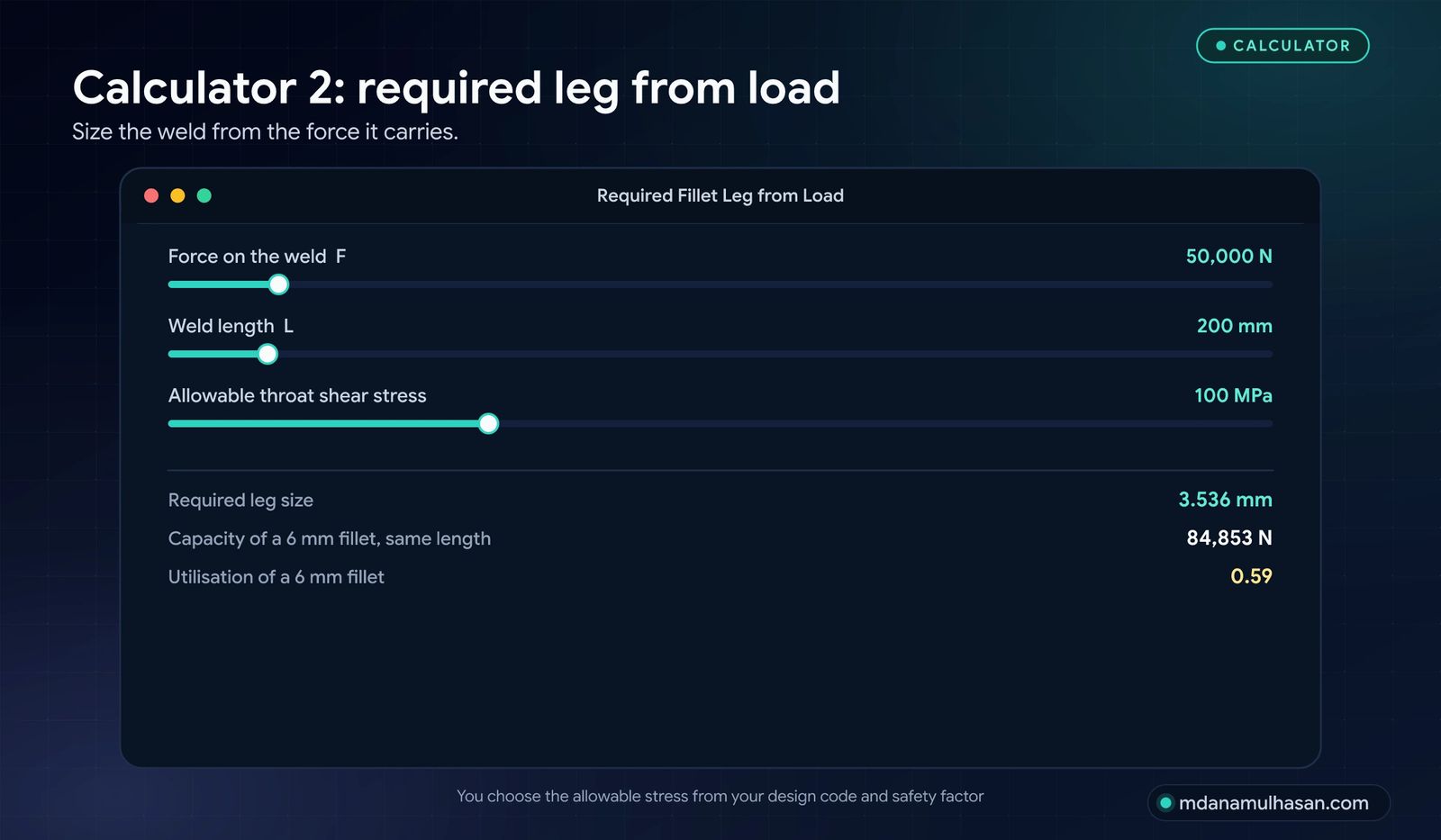
Size the weld from the force it carries, not from the plate thickness. The defaults (50 kN over 200 mm of weld at 100 MPa allowable throat stress) give a required leg of 3.54 mm.
Interactive calculator — enable JavaScript to use.
- Force on the Weld (F)
- Weld Length (L)
- Allowable Throat Shear Stress
Seam cost: continuous against stitch
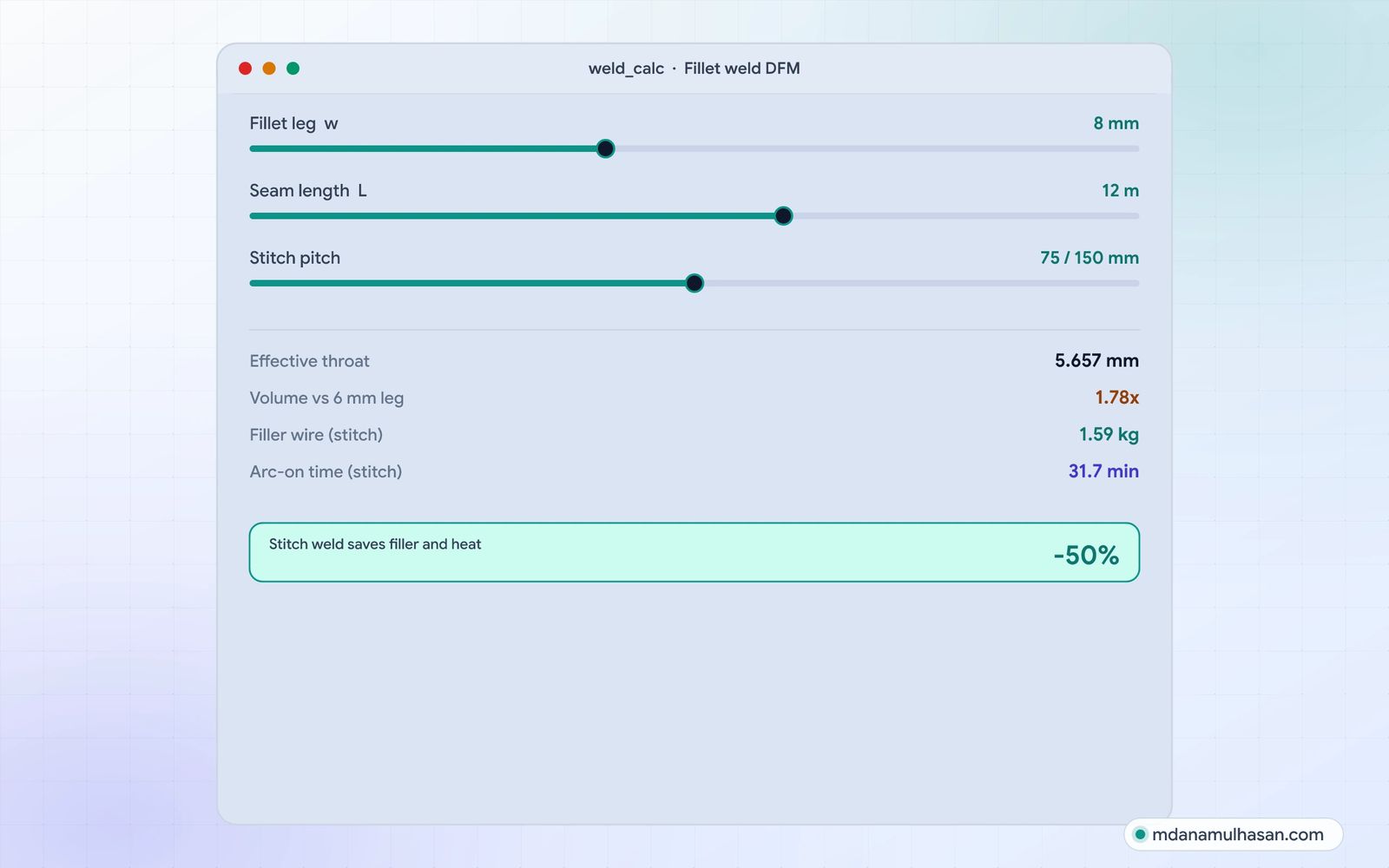
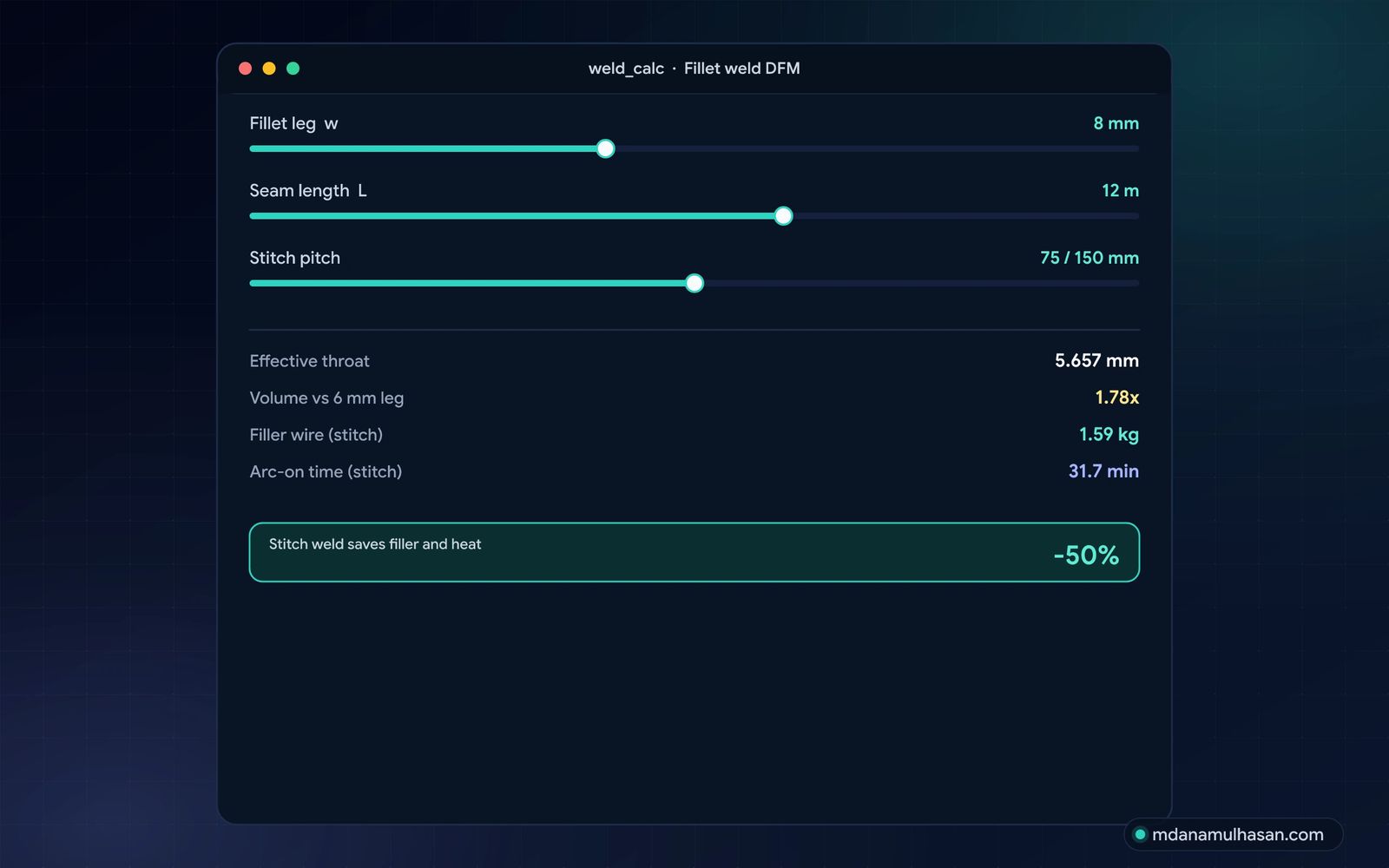
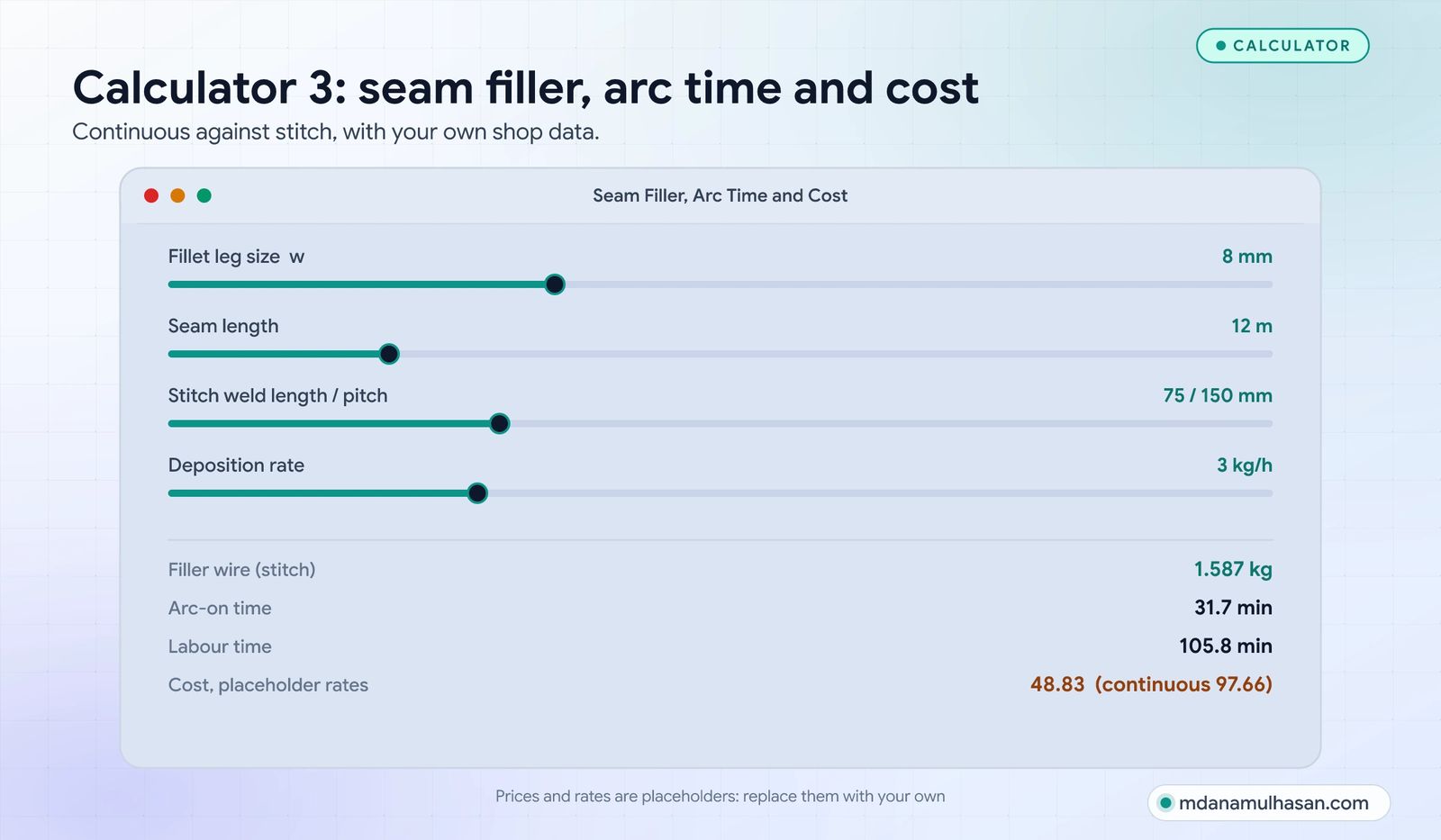
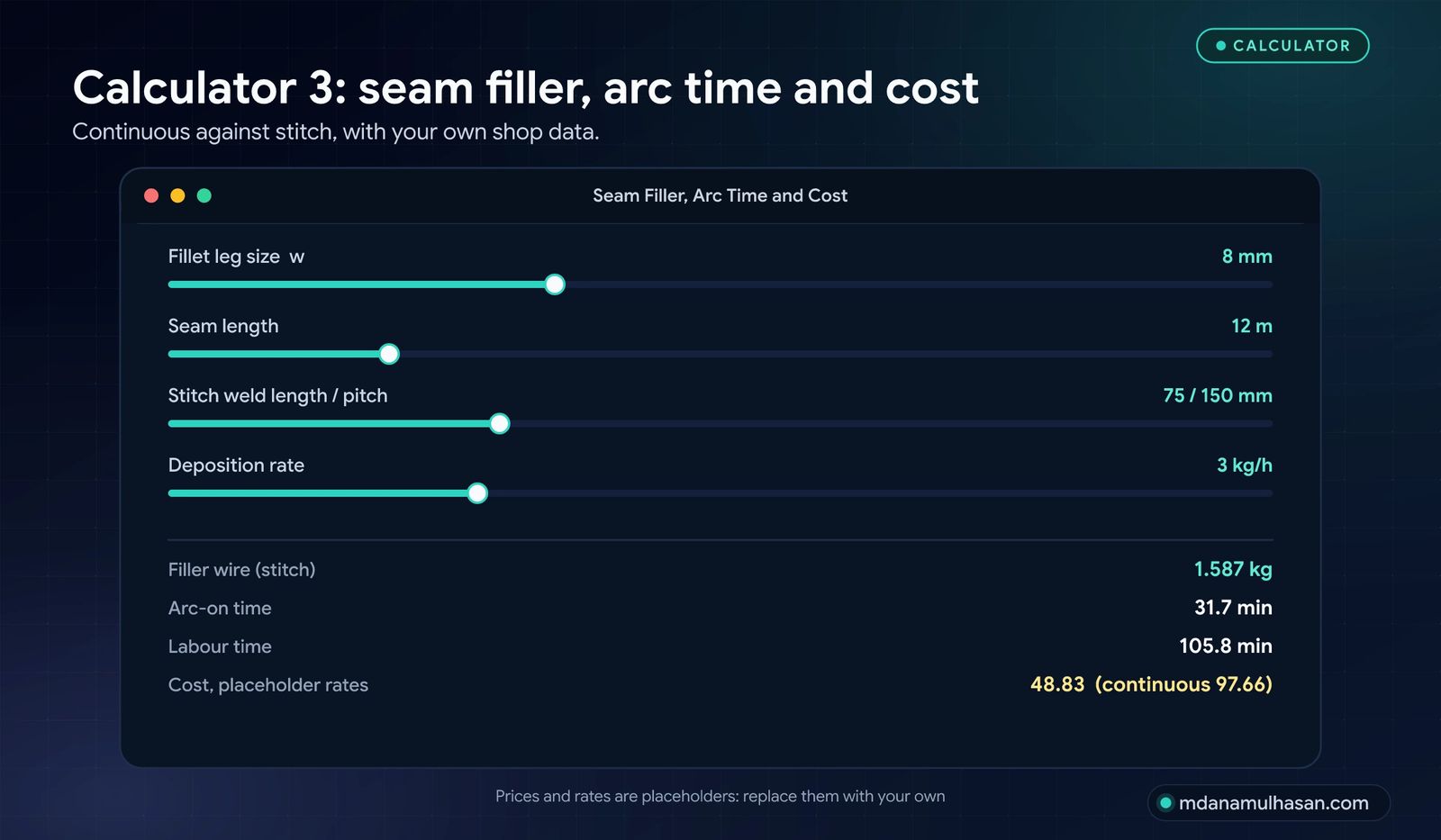
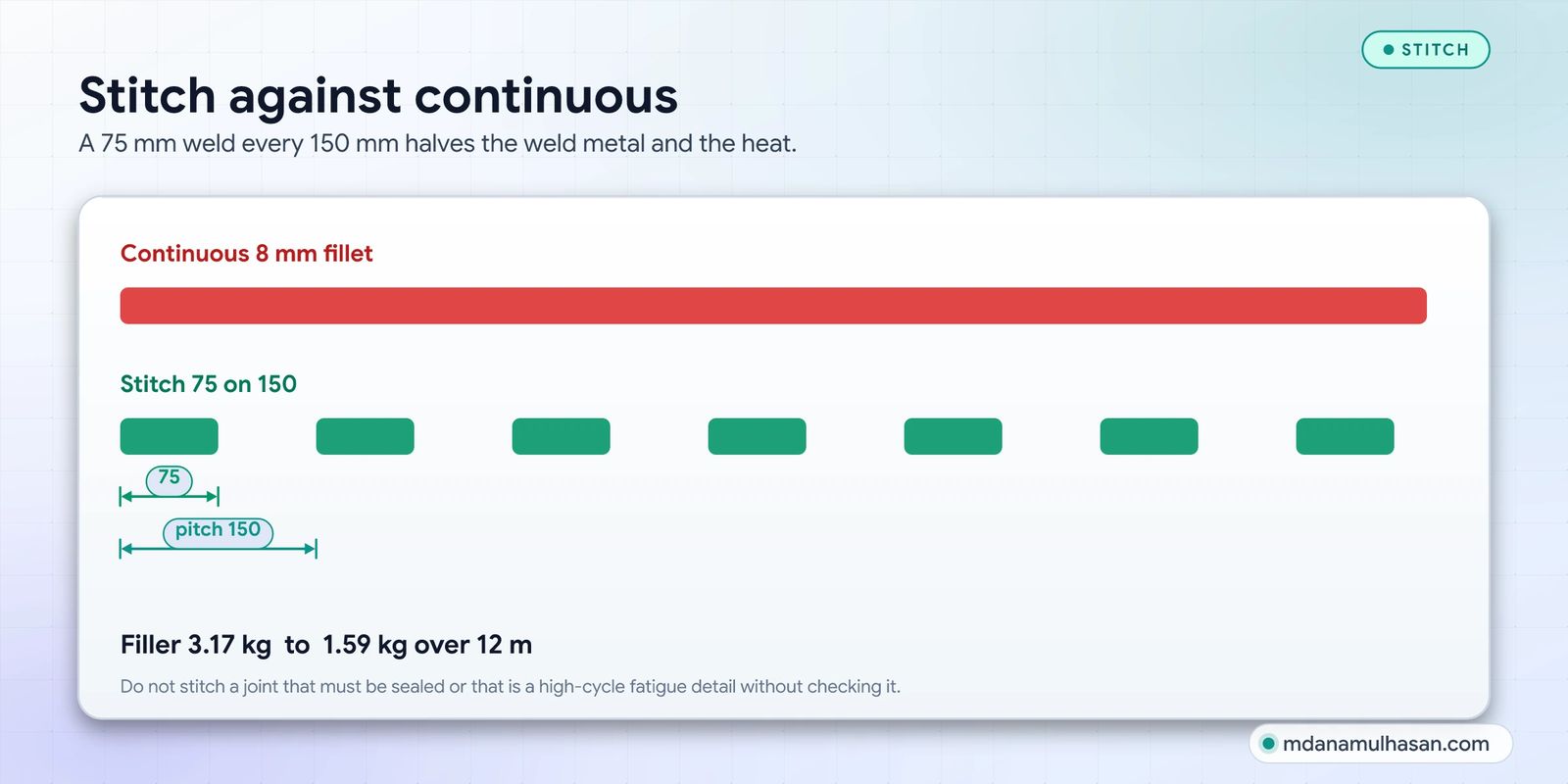
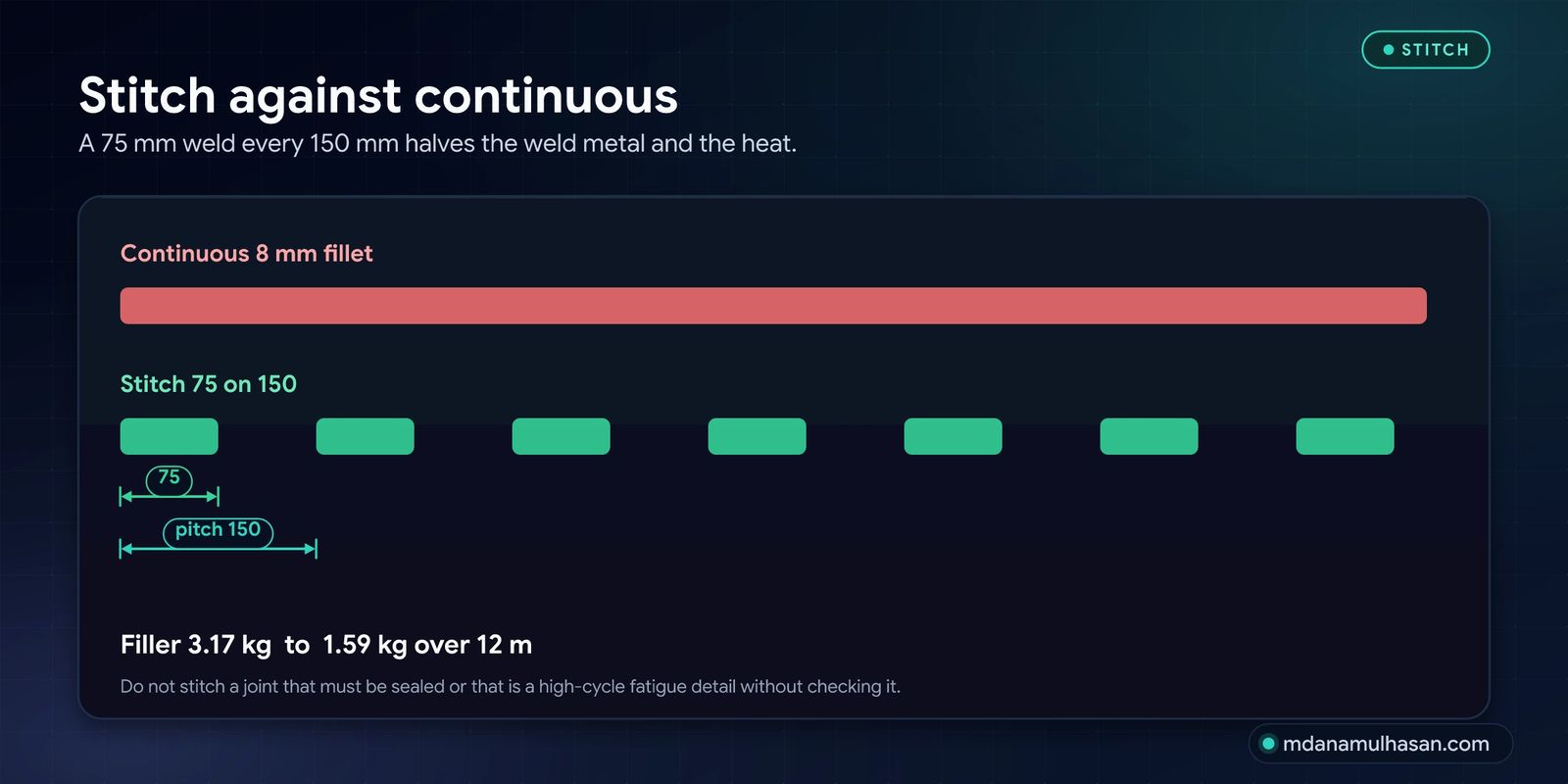
An 8 mm fillet over 12 m of seam. A 75 mm weld every 150 mm halves the filler and the arc time. Set the weld length equal to the pitch for a continuous weld. The prices are placeholders: replace them.
Interactive calculator — enable JavaScript to use.
- Fillet Leg Size (w)
- Seam Length
- Stitch Weld Length
- Stitch Pitch (set equal to weld length for continuous)
- Deposition Rate (arc on)
- Operator Factor (arc-on share of labour time)
- Filler Wire Price
- Labour Rate
The Python module
weld_calc.py uses the same formulas, runs its own self-test and needs nothing but Python 3.9 or newer.
- weld_calc.py: standard library only.
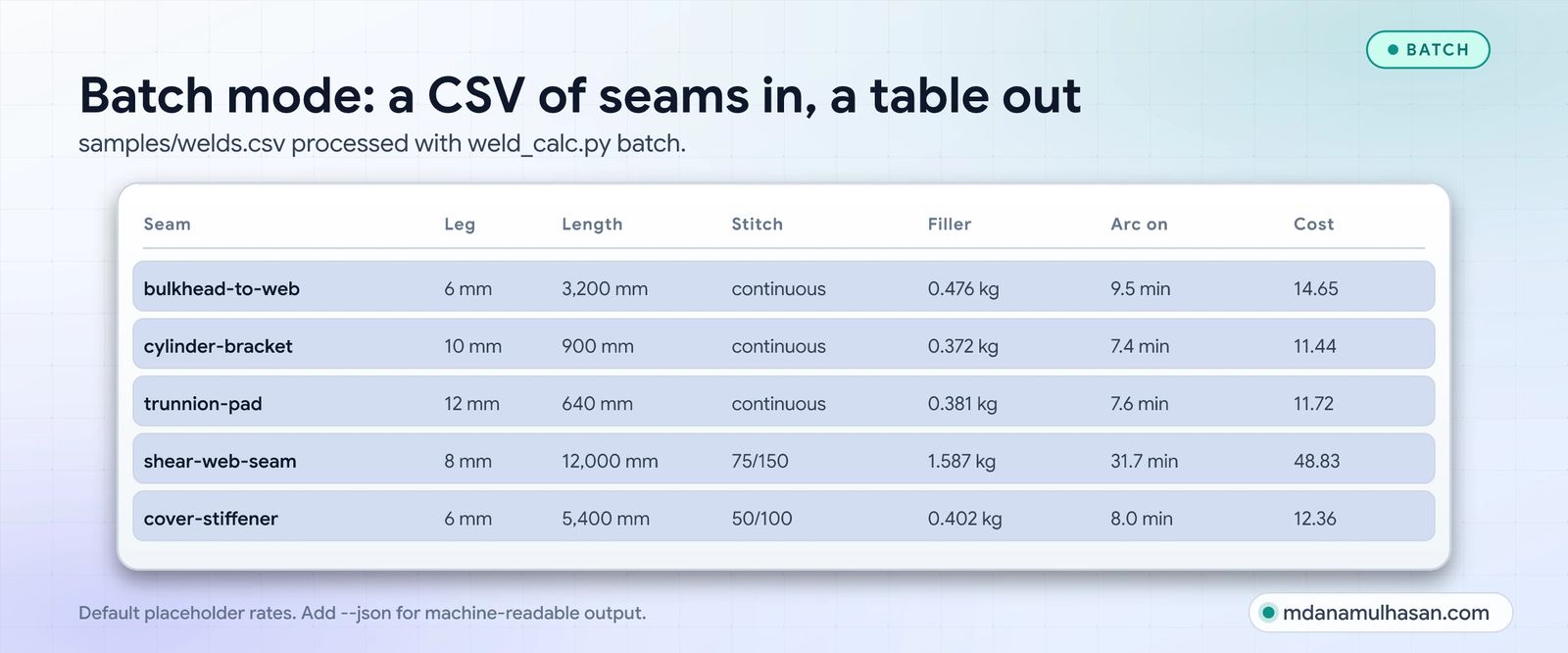
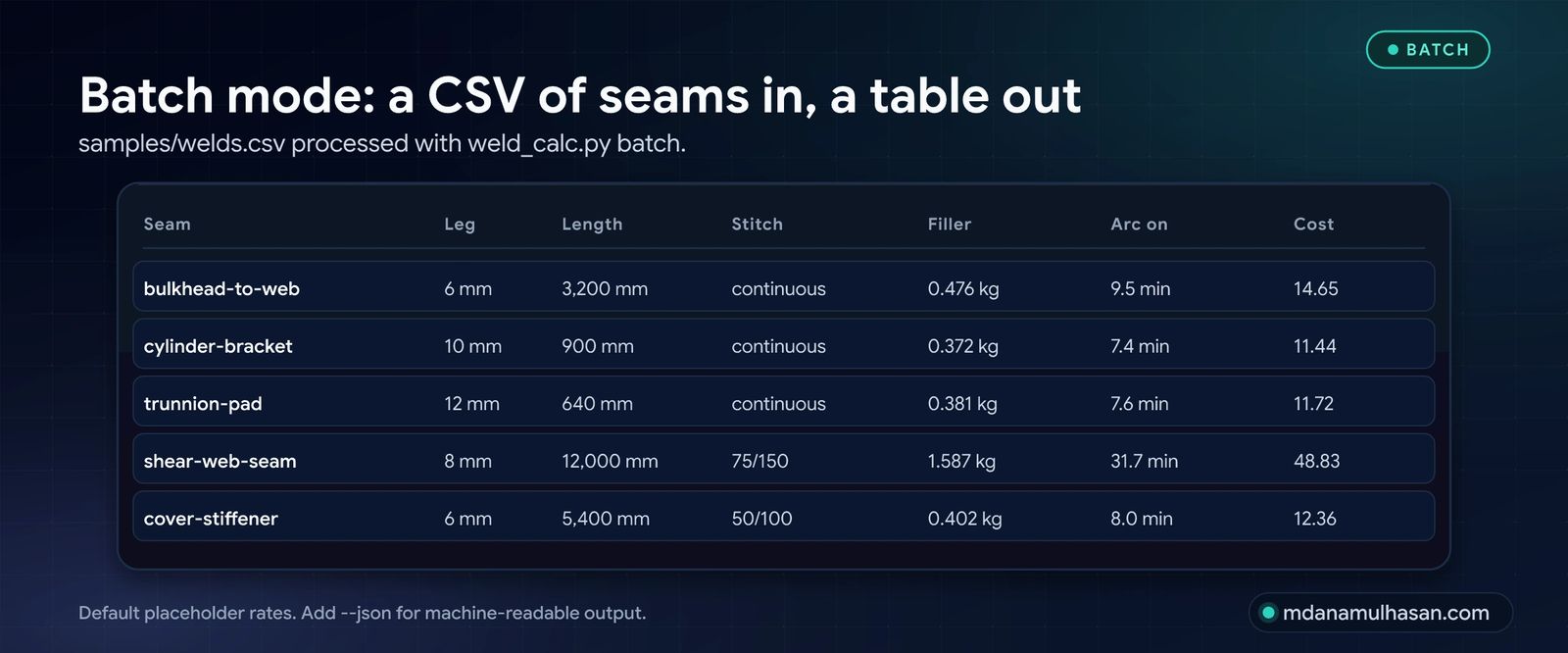
- welds.csv: sample batch input.
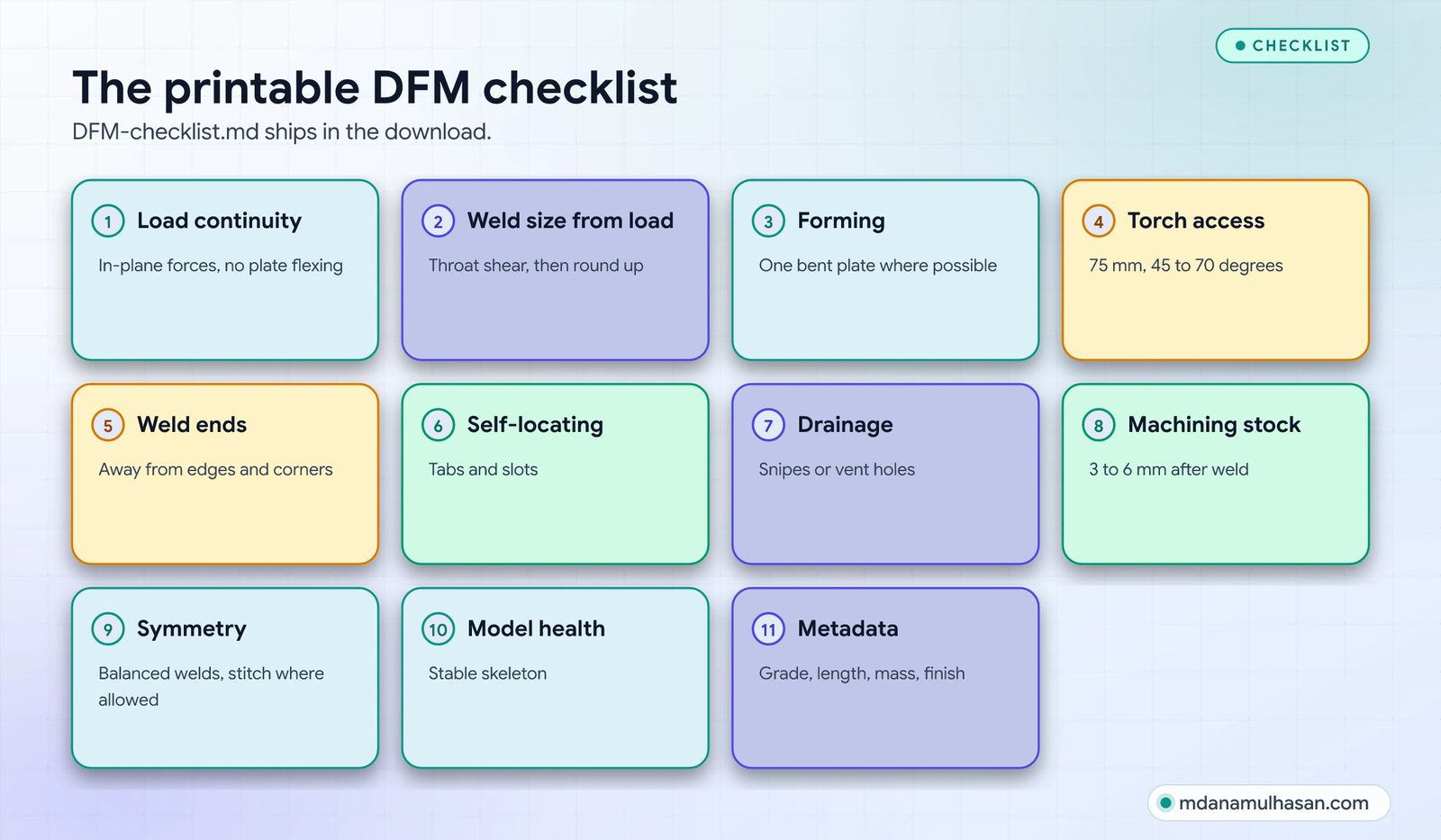
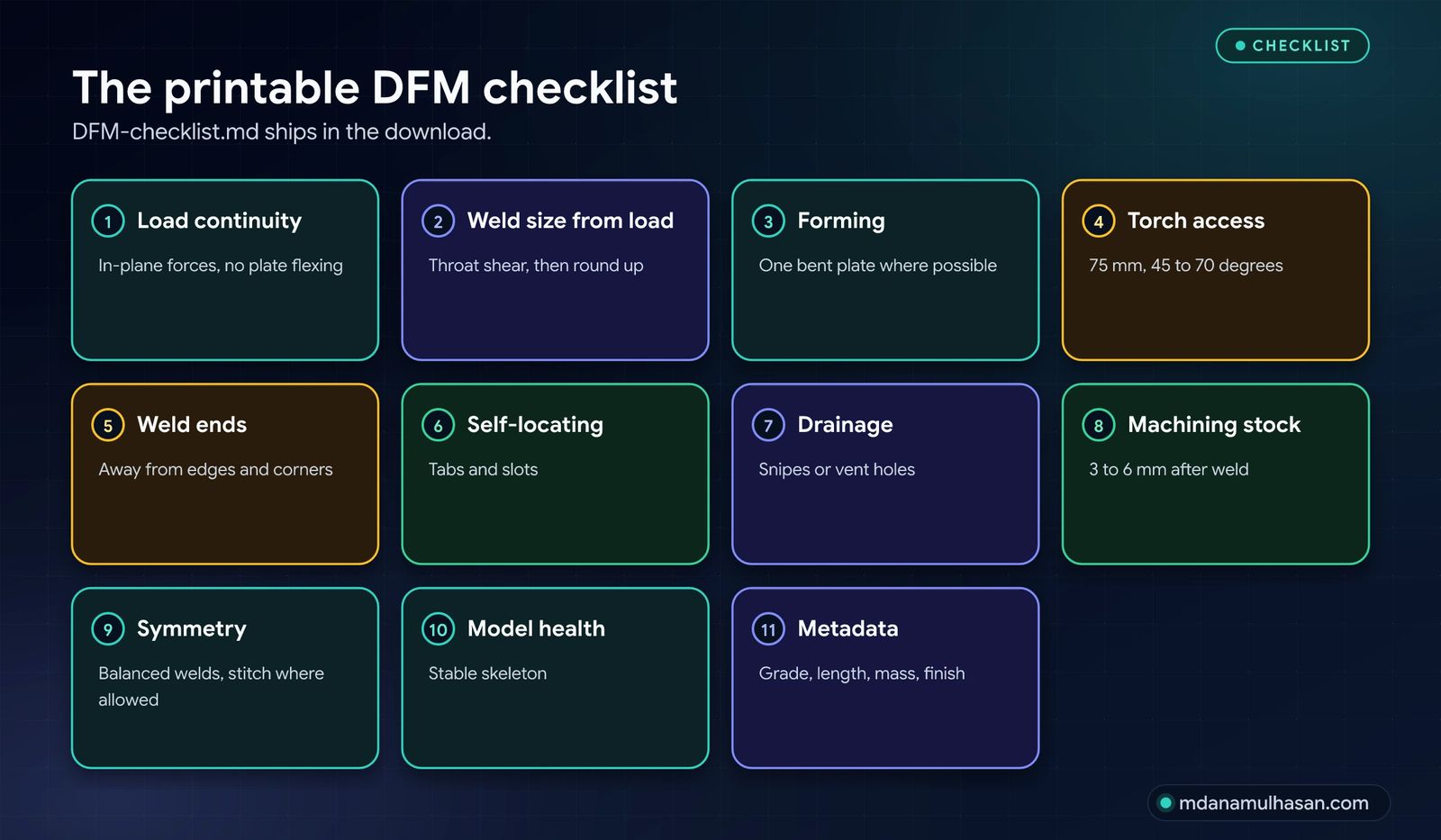
- DFM-checklist.md: the sign-off checklist from the article.
python weld_calc.py                              # self-test and worked examples
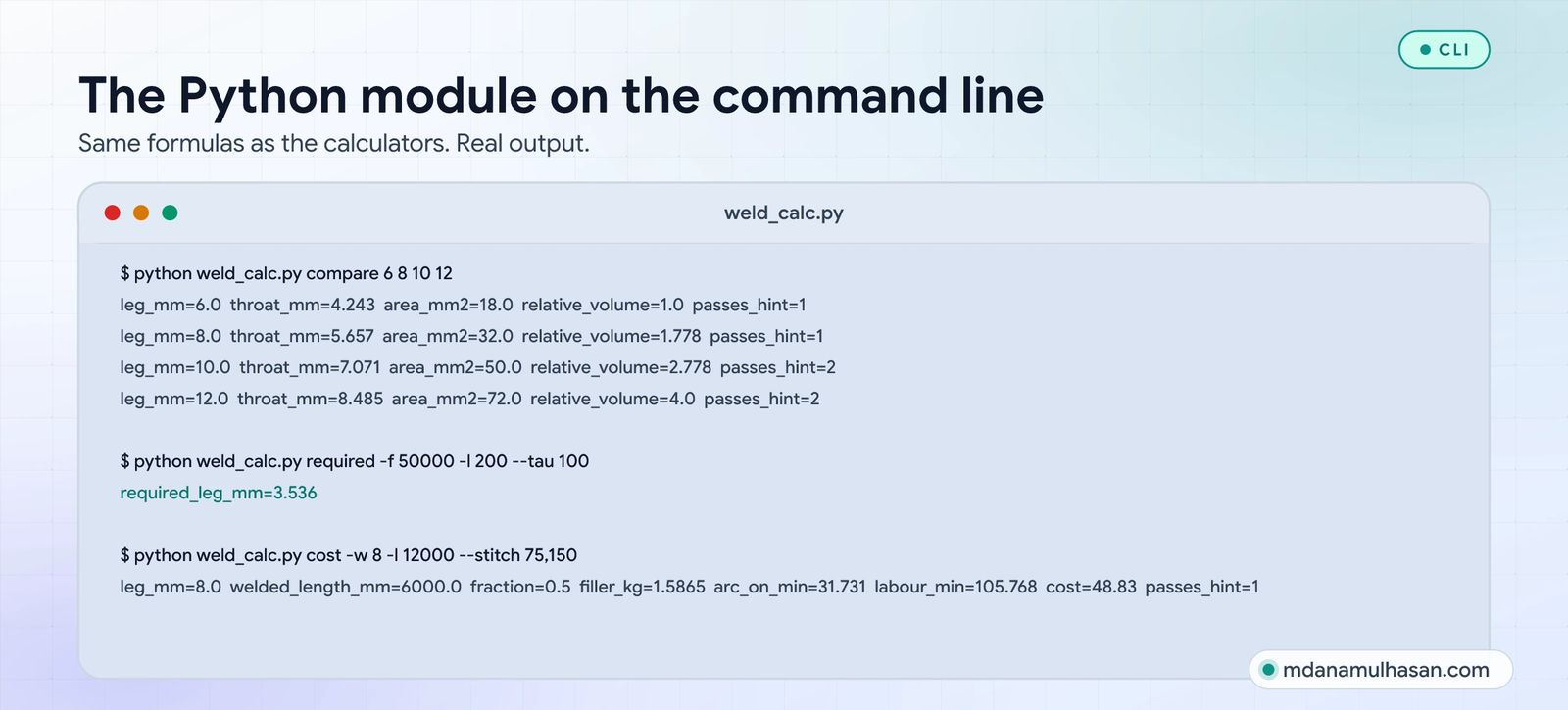
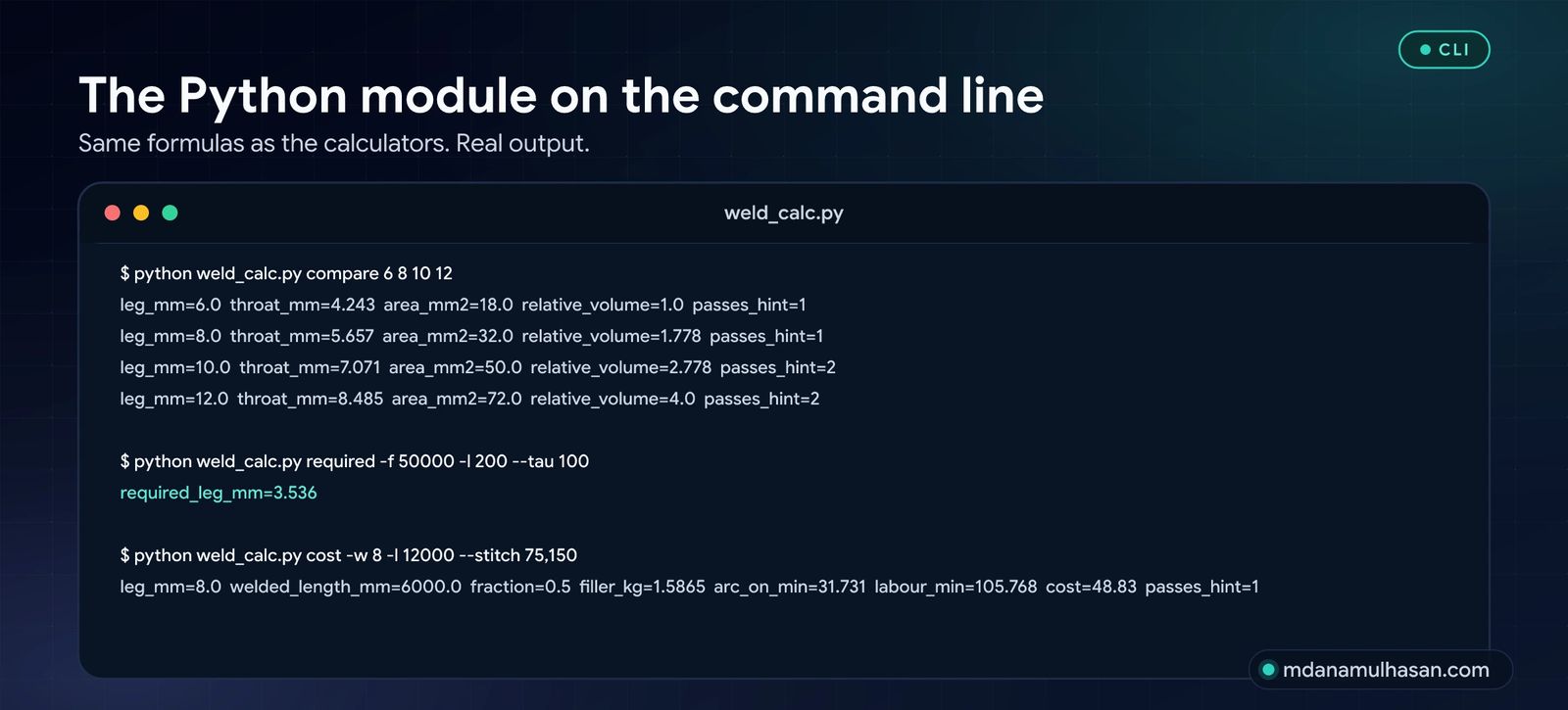
python weld_calc.py compare 6 8 10 12
python weld_calc.py required -f 50000 -l 200 --tau 100
python weld_calc.py cost -w 8 -l 12000 --stitch 75,150
python weld_calc.py batch welds.csv --json
For the 8 mm fillet over 12 m, the stitch weld prints:
filler_kg=1.5865 arc_on_min=31.731 labour_min=105.768 cost=48.83 (continuous: 3.1731 kg, 63.461 min, 97.66)
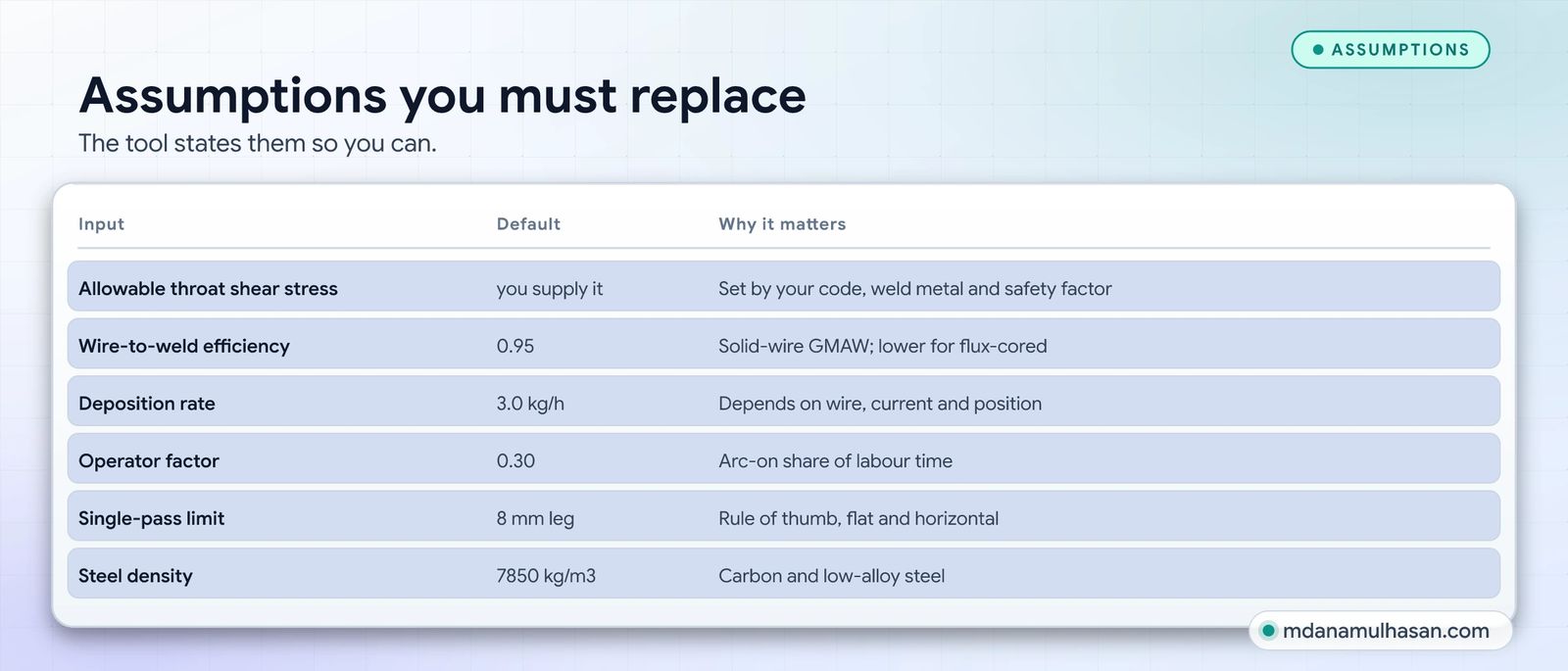
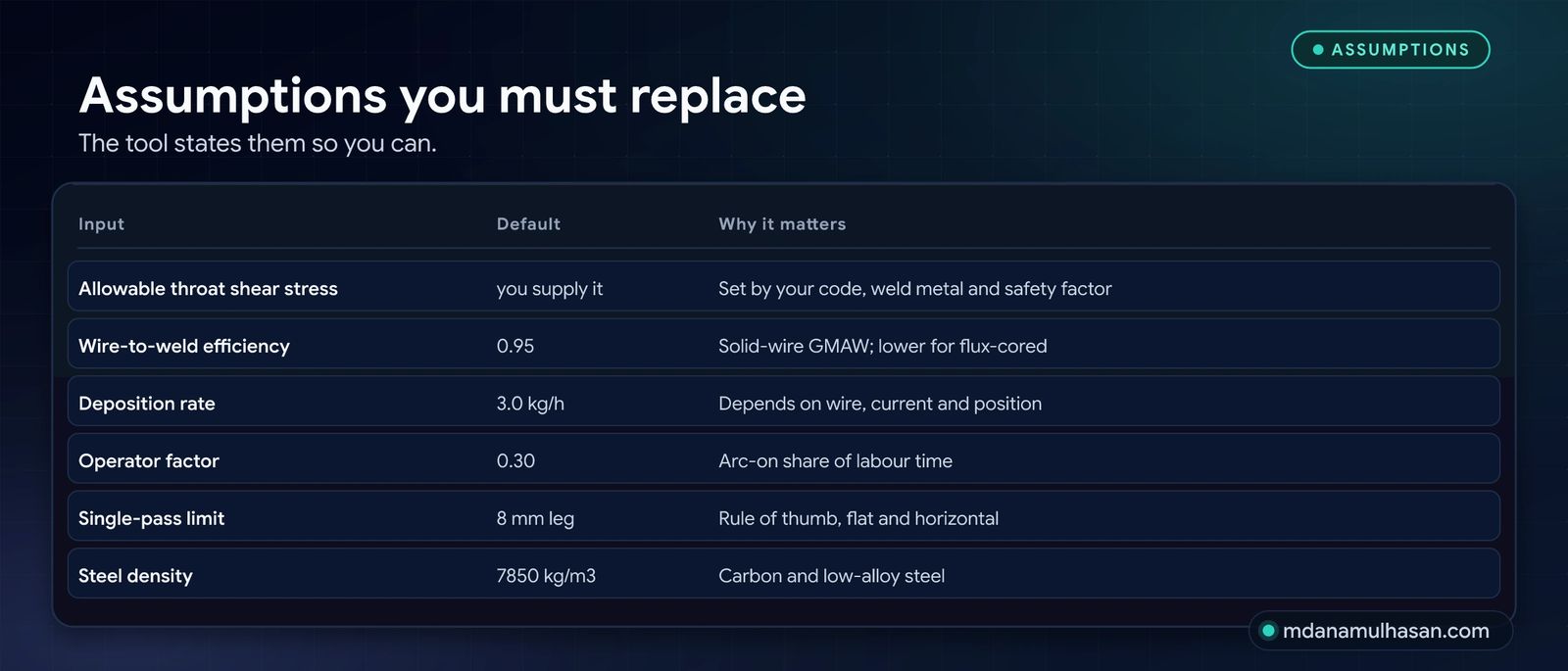
Assumptions to replace
| Input | Default | Why it matters |
|---|---|---|
| Allowable throat shear stress | you supply it | Comes from your design code, weld metal and safety factor. |
| Wire-to-weld efficiency | 0.95 | Solid-wire GMAW. Lower for flux-cored or open-arc processes. |
| Deposition rate | 3.0 kg/h | Depends on wire, current and position. |
| Operator factor | 0.30 | Share of labour time with the arc on; manual welding is well below 1. |
| Single-pass limit | 8 mm leg | A rule of thumb for flat and horizontal semi-automatic welds. |
| Steel density | 7850 kg/m3 | Carbon and low-alloy structural steel. |
Good to know
- Nominal area only. Real fillets have reinforcement and root penetration, so order consumables from your own deposition data.
- Equal-leg, in-plane shear. The capacity formula covers a fillet loaded in shear on the throat. Combined loading, fatigue and weld groups need your code.
- Local. The calculators run in your browser and the script runs on your machine. Nothing is uploaded.
Want weldments reviewed for manufacturability, or your CAD and cut-list flow automated? Get in touch.
- Type
- Calculator
- Format
- Python script
- Download size
- 12 KB
- Price
- Free
- License
- MIT
Using the calculator
Pick the leg from load
Enter force, weld length and your allowable throat stress.
Compare options
See the volume, filler and arc time of other leg sizes or a stitch pattern.
Review before release
Print the checklist and sign off the weldment.
What the calculator does
Throat and volume
Effective throat, nominal area and volume against a 6 mm fillet.
Required leg from load
Smallest equal-leg fillet for a force, length and allowable stress.
Stitch against continuous
Filler wire, arc-on time and cost for a seam, continuous or intermittent.
Python module and batch CSV
size, required, cost, compare and batch commands, with JSON output.
DFM sign-off checklist
The printable checklist from the article.
Honest by design
Rejects bad inputs and states every assumption you must replace.
The calculator at a glance
Get the calculator
About 12 KB. Requires Python 3.9+ for the module; the calculators run in your browser.
weld_calc.py
Questions, answered
Does it check my weld against a design code?
No. It compares options and estimates filler and arc time. Allowable stress, combined loading and fatigue belong to your code and welding engineer.
Why is the weld volume only an estimate?
It uses the nominal fillet area, which ignores reinforcement and root penetration. Use it to rank options, not to order wire.
Where do the default rates come from?
They are placeholders. Replace the deposition rate, operator factor and prices with your own shop data.
Share this engineering resource
Recommend this calculator to colleagues.